SaaS outbound checklist (minimum viable system)
| Layer | What “good” looks like | Failure mode |
|---|---|---|
| ICP + offer | One buyer title cluster, one clear outcome | Spray messaging across 8 personas |
| Data | Waterfall-verified work emails, <1% hard bounce | Raw Apollo export → spam folder |
| Infrastructure | Secondary domains, SPF/DKIM/DMARC, warmup | Sending from the primary root domain |
| Sequencing | Email + LinkedIn, 3–5 touches, human replies | 30-step automation with AI slop |
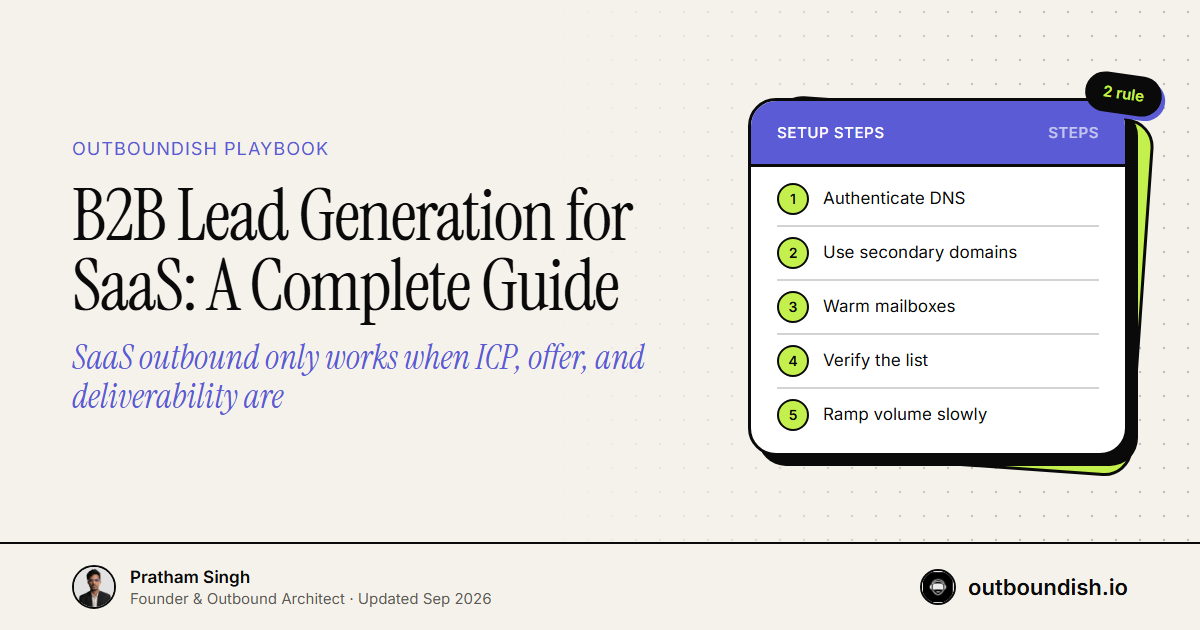
SaaS outbound only works when ICP, offer, and deliverability are engineered together. This guide covers list building, secondary-domain infrastructure, sequencing, and the meeting math behind predictable pipeline.
The SaaS Growth Trap
When SaaS founders launch their product, they immediately dump money into Facebook and Google ads. They expect a flood of inbound leads. Six months later, they have a massive customer acquisition cost (CAC) and an empty sales pipeline.
Inbound marketing takes months to mature. If you need enterprise demos on the calendar this week, you need an outbound lead generation engine.
Selling the Vacation
SaaS founders love their own products. As a result, their cold emails are usually filled with boring technical details about their proprietary algorithms and seamless integrations. Buyers do not care about your features.
To win in SaaS lead generation, you must sell the outcome. Stop talking about the technical mechanisms. Talk entirely about the missed revenue you are going to capture, the hours of manual labor you are going to eliminate, or the compliance risks you are going to solve.
Target the Right Seniority
Stop emailing lower-level managers who have no purchasing power. Use precise firmographic data to target VP and C-Level executives directly. They are the ones feeling the pain of inefficiency, and they hold the budget to authorize your SaaS solution.
The SaaS outbound operating loop
Treat outbound as a weekly operating system, not a campaign you “launch once.” Every week you should refresh a slice of ICP accounts, verify new contacts, ship a small batch of tests, and review reply reasons—not vanity open rates.
- Pick one wedge ICP (title + employee band + trigger). Breadth kills personalization and deliverability.
- Build infrastructure off the root domain so customer and investor email stays insulated.
- Write one offer thesis in plain language: who it’s for, what changes, why now.
- Measure held meetings and show rate, then work backwards into copy and lists.
If you cannot explain the math from contacts → replies → held meetings → opportunities, you do not have a SaaS outbound system yet—you have activity.
Weekly SaaS outbound rhythm
Outbound compounds when it is operated weekly, not launched quarterly.
- Refresh one ICP wedge and exclusion list.
- Verify a new contact batch before send.
- Ship one copy test with a clear hypothesis.
- Review reply reasons and held-meeting quality.
- Only then increase domain/mailbox volume.
Activity metrics without meeting quality create false confidence. Optimize for held ICP meetings first.
Want dedicated secondary inboxes, multi-pool mailbox rotation, and guaranteed primary placement managed for your team? Explore how our done-for-you cold email agency infrastructure pods run outbound without risking your domain portfolio.
People Also Ask
Outbound. Paid social and SEO take months to mature; a verified list plus email and LinkedIn can put Director and VP demos on the calendar in weeks. That only holds if you sell an outcome, not a feature dump.
Target the buyer with budget: VPs and C-level who own the pain. Lower-level managers can champion later; they rarely authorize a $15k–$100k ACV contract from a cold email.
Founders pitch algorithms and integrations. Buyers buy recovered revenue, hours saved, or risk removed. Put the missed outcome in under 75 words and skip the architecture tour.
After the offer converts and the constraint is volume and ops, not learning. That is when a $1,000–$2,000 per month engine compounds a proven motion instead of experimenting on your brand.