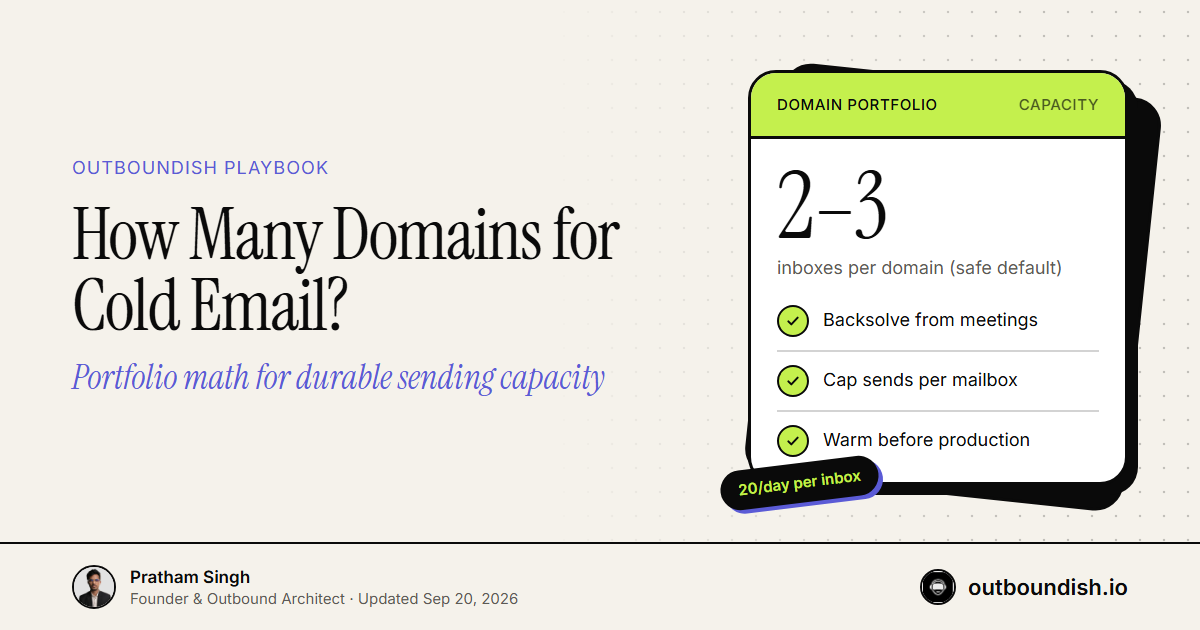
Domain count is not a superstition. It is capacity planning: meetings goal → required sends → mailboxes → domains → warmup buffer. If you skip the math, you either under-build and stall—or over-buy and warm empty infrastructure.
What a domain portfolio actually is
A cold email domain portfolio is a set of secondary lookalike domains, each with a small number of mailboxes, authenticated (SPF/DKIM/DMARC), warmed, and capped so no single inbox or domain carries unsafe volume. Your primary corporate domain stays off the firing line.
This is different from “buy one secondary domain and pray.” Portfolio design assumes failure is normal: one domain can get filtered; the system should keep sending.
For the DNS and warmup mechanics, use the setup playbook: How to Set Up Email Domains for Outbound Campaigns. This article answers how many.
The capacity formula
Work backwards from held meetings—not from a round number of domains.
| Input | Conservative default |
|---|---|
| Target held meetings / month | 20–30 |
| Positive reply → held rate | 20–35% (varies by offer) |
| Overall reply rate | 1–4% on cold |
| Sends needed / month | Meetings ÷ (reply% × positive→held%) |
| Business days | ~20 |
| Safe sends / mailbox / day | ~15–25 after warmup |
| Inboxes / domain | 2–3 |
Rough capacity:
Daily send capacity ≈ mailboxes × sends_per_mailbox
Domains ≈ ceil(mailboxes ÷ inboxes_per_domain)
Then add 20–40% buffer for warmup, pauses, and burned assets.
Public operator guidance often clusters around 2–3 inboxes per domain and modest daily caps per mailbox. Treat those as planning defaults, then tighten if complaint or bounce rates rise. For inbox placement diagnostics, see Cold Email Deliverability: Why You're Landing in Spam.
Worked example: 20–30 held meetings / month
Assume:
- 25 held meetings / month target
- 2.5% total reply rate
- 25% of replies become held meetings
Emails / month ≈ 25 ÷ (0.025 × 0.25) = 4,000
Per business day ≈ 200 sends/day
At 20 sends/mailbox/day → 10 mailboxes
At 2–3 inboxes/domain → 4–5 domains in production
Add warmup/spare domains so you are not blocked when one asset pauses. Many teams keep a parallel warm pool equal to ~25–50% of production capacity.
This is why “just buy 50 domains” without a meeting math model is cargo cult. Buy for the funnel you can actually operate.
Inboxes, caps, and provider reality
Mailbox caps are reputation management, not Google folklore alone. Ramp slowly after authentication. If hard bounces creep up, stop adding domains—fix the list. Domain shopping cannot repair catch-all spam traps.
Google publishes sender guidelines for bulk senders; authentication and low spam rates are non-negotiable. Read the current Google Email Sender Guidelines before you scale.
Failure modes that burn portfolios
| Symptom | Likely cause | Fix |
|---|---|---|
| Sudden spam placement | Aggressive ramp / weak DNS | Pause, verify SPF/DKIM/DMARC alignment |
| Rising hard bounces | Bad verification | Re-verify; kill catch-alls |
| One domain “dies” | Concentrated volume/complaints | Spread volume; replace asset |
| Capacity cliff | No warm buffer | Always warm the next tranche early |
When to buy more domains vs fix the offer
Buy more domains when:
- Caps are hit and bounce/complaint rates are healthy
- Reply quality is acceptable
- Warm pool is ready
Do not buy more domains when:
- Copy gets polite ignores
- ICP is fuzzy
- Hard bounces are elevated
Unit economics still win: see Cost per Qualified B2B Sales Meeting Benchmarks.
Bottom line
Start from held meetings. Convert to sends. Convert to mailboxes. Convert to domains. Add buffer. Authenticate and warm before production. That is a portfolio—not a shopping cart of domains.
People Also Ask
Enough to cover your daily send target at safe per-mailbox caps with 2–3 inboxes per domain, plus a warmup buffer. Backsolve from meetings, not vibes.
Most durable setups stay around 2–3 sending inboxes per domain so blast radius stays contained if reputation drops.
After warmup, many teams keep cold volume in a conservative band—often roughly mid-teens to mid-twenties per day—raising only while bounce and complaint metrics stay clean.
Domains create send capacity. Meetings come from ICP, offer, and reply handling. Infrastructure enables volume; it does not replace targeting.