Contact list quality scorecard
| Check | Pass | Fail |
|---|---|---|
| Title match | Exact ICP titles only | “Marketing” catch-all |
| Email verify | Multi-provider + catch-all rejection | Single-source “valid” |
| Freshness | Scraped/enriched recently | Year-old CSV |
| Suppression | Customers, competitors, prior unsubs removed | No suppression file |
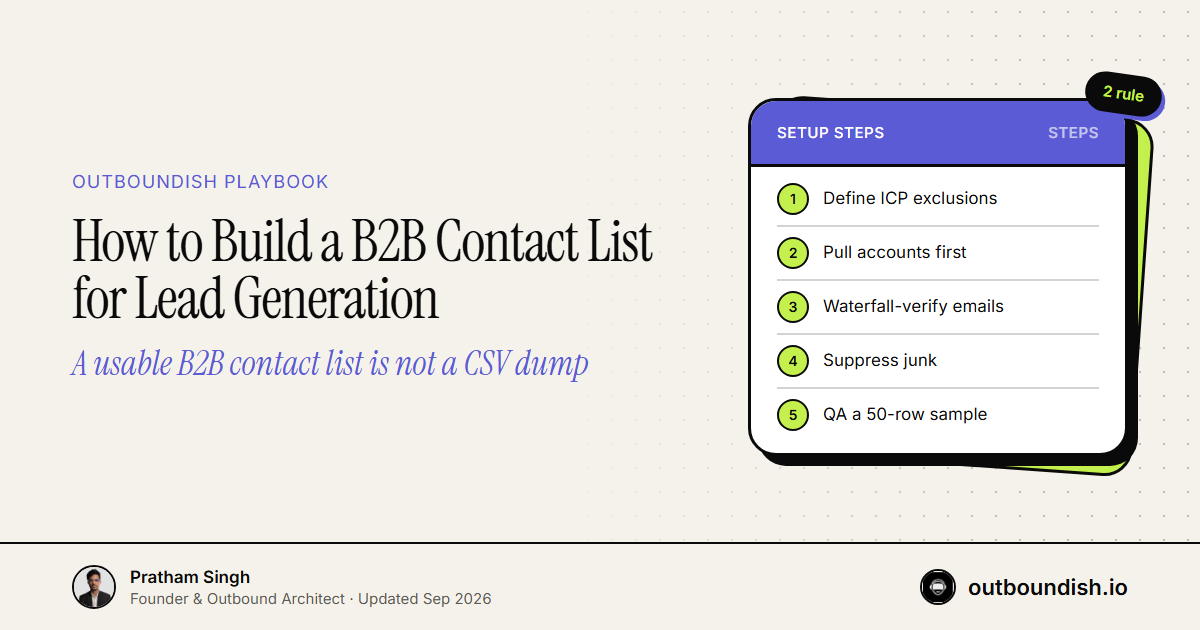
A usable B2B contact list is not a CSV dump. Define ICP tightly, pull from Sales Navigator/Apollo, waterfall-verify emails, and suppress catch-alls before a single cold send.
If Your List is Wrong, Nothing Else Matters
You can write the most brilliant, persuasive cold email ever crafted, but if it lands in the wrong inbox, it is worthless. The foundation of all B2B lead generation is the contact list.
Most teams simply filter generic databases by "Job Title" and "Industry." This is why their campaigns fail. You end up targeting thousands of people who have absolutely no immediate need for your service.
Layering Your Data
To build a list that actually converts, you must layer your targeting criteria. A high-converting list requires three layers:
- Firmographics: Filter by exact company revenue and employee headcount. Make sure they can actually afford your product.
- Technographics: Find out what software they are currently paying for. If you sell a HubSpot integration, only pull lists of companies actively using HubSpot.
- Buyer Intent: The holy grail. Find companies that are actively researching solutions like yours across the web right now.
Quality Over Quantity
We would much rather target 500 verified, in-market leads than 5,000 "maybe" leads. Accuracy protects your domain reputation and ensures your sales team spends their time closing deals instead of dealing with bounced emails.
Step-by-step list build (no junk CSV)
- Write the ICP in negatives as well as positives (who you will not contact).
- Pull accounts first from Sales Navigator / firmographic filters, then people.
- Enrich emails with a waterfall (multiple providers) and reject risky catch-alls.
- Sample 50 rows manually before scaling. If titles are fuzzy, the whole list is fuzzy.
- Load suppressions (customers, open opps, competitors, prior unsubs) before send.
A smaller clean list outperforms a larger dirty one on both reply quality and domain health.
List ops checklist before the first send
Most deliverability damage starts in the list, not the subject line. Treat list building as a quality gate.
- Write ICP inclusions and exclusions in plain language.
- Build accounts first, then people (not random title scraping).
- Waterfall-verify emails and reject risky catch-alls.
- Suppress customers, open opportunities, competitors, and prior unsubscribes.
- Spot-check 50 rows manually for title drift and wrong company matches.
If the sample fails, the full list fails. Fix filters before buying more tools.
Want dedicated secondary inboxes, multi-pool mailbox rotation, and guaranteed primary placement managed for your team? Explore how our done-for-you cold email agency infrastructure pods run outbound without risking your domain portfolio.
People Also Ask
Layer firmographics (revenue, headcount), technographics (the stack they already pay for), and intent (hiring, funding, research). Title-plus-industry dumps are why campaigns bounce and nobody buys.
No. Five hundred verified, in-market contacts beat 5,000 maybes. Hard bounces wreck domain reputation; SDRs chasing bad emails wreck pipeline.
Waterfall enrichment across multiple providers, then verify before the sequencer. One Apollo export is not ground truth.
Copy, domains, and SDRs cannot save it. The message lands in the wrong inbox, so every other metric is theater.