Most linkedin lead generation messages read like a bad email forward: "Hope you're well," feature dump, Calendly. Buyers delete them on sight. Then sellers blame the channel while competitors book meetings with four-line notes that sound human.
The Brutal Truth
Outboundish writes LinkedIn as a precision lane next to email inside $1k–$2k/mo systems aimed at ~$100–$150 per held meeting. The message is not the product. The product is a held conversation with an ICP buyer. Copy either serves that or it is content cosplay.
Connection Notes vs DMs vs InMail
| Format | Use when | Keep it |
|---|---|---|
| Connection note | Real trigger or mutual context | Ultra short; optional blank if no trigger |
| First DM after accept | You earned attention | Context → problem → proof → ask |
| Follow-up DM | They opened or replied soft | One new angle; no nag stack |
| InMail | High ACV, not connected | Paid; still short; easy opt-out vibe |
Linkedin lead generation messages fail when every stage uses the same paragraph. Match length to trust earned.
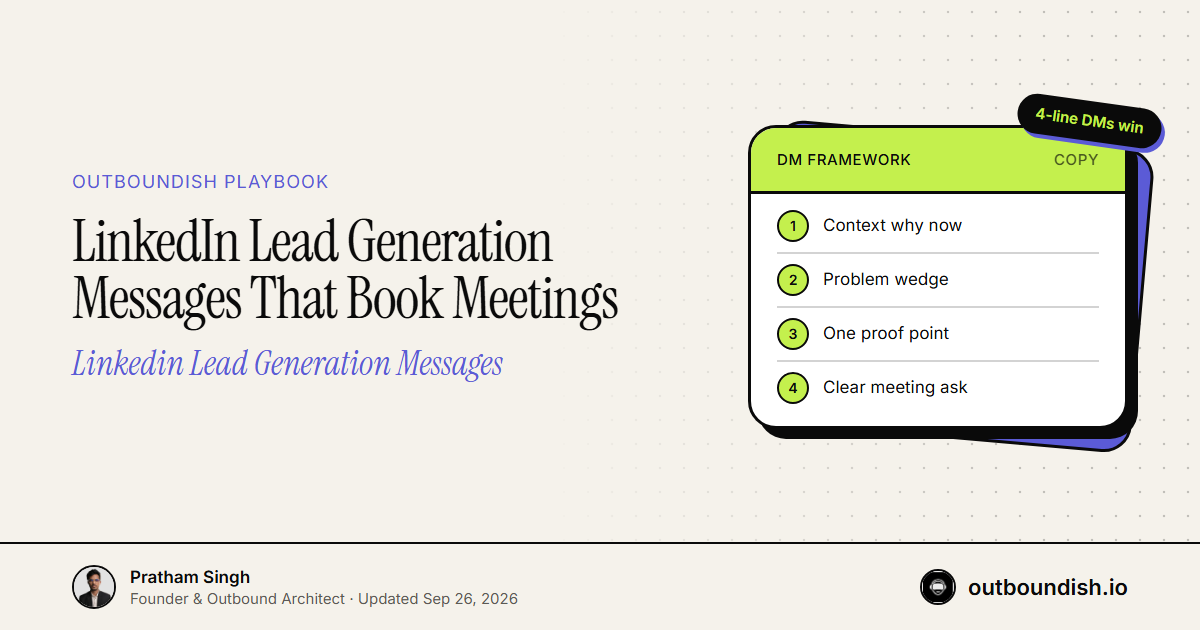
The Four-Line DM Framework
- Context — why them, why now (trigger, peer pattern, prior email)
- Problem wedge — one sentence they recognize
- Proof — peer, metric, or artifact
- Ask — specific times or a one-question qualifier
Example shape (adapt hard; do not clone blindly):
Noticed you are hiring AEs while expanding mid-market. Teams at that stage usually under-build outbound infrastructure and over-hire. We helped a similar SaaS team stabilize held meetings without adding headcount. Open to a 15-minute teardown of your current funnel?
That is what good linkedin lead generation messages feel like: specific, calm, easy to answer. If the prospect can reply with one word ("sure" / "timing" / "send times"), you wrote it right.
What to Kill Immediately
- "Loved your post" with no proof you read it
- Attachment dumps and PDF pitches in first touch
- Fake first-name personalization at industrial scale
- Five-message nag sequences with zero new information
- Pitching three products in one note
If acceptance or positive rates fall, stop volume and rewrite. Pushing harder with the same weak copy is how accounts get restricted. A/B one variable at a time: opener, proof, or ask—not a full rewrite every day that teaches you nothing.
Multi-Thread Without Being Weird
For deals that justify it, message a champion and later an economic buyer—spaced days apart, not a same-day swarm. Reference lightly: "Spoke with Priya on deliverability—wanted the budget-owner view." Multi-threading is navigation. Swarming is spam.
Pair with email so LinkedIn is not carrying all volume. A simple pattern: email open + connection day 1, proof email day 3, DM day 5 if connected. Shared ICP and offer across channels. That is how linkedin lead generation messages become part of a meeting system instead of a lonely DM hobby.
Follow-Ups That Do Not Beg
Second touches should add information: a peer metric, a one-line teardown observation, or a sharper qualifier question. "Just bumping this" is not a strategy. If two thoughtful follow-ups earn silence, stop. Silence is data. Move to the next ICP account instead of camping in their inbox.
Metrics for Message Quality
| Metric | Signal |
|---|---|
| Acceptance rate | Note / targeting health |
| Positive DM rate | Offer + clarity |
| Meetings from LinkedIn threads | Real conversion |
| Show rate | Booking ops quality |
| Opportunities | Revenue path |
Track which angles earn meetings. Kill losers weekly. Winners should stay boring and consistent—creative novelty is not a KPI. Screenshot libraries of "clever" DMs impress founders and rarely survive contact with real buyers.
Safety and Tone
Platform limits move. Stay conservative. Warm accounts. Avoid aggressive automation that scrapes and blasts from the same login overnight. Write like a peer, not a bot farm. Voice notes can help sparingly after connection; blasting voice notes feels invasive.
If you hire help, demand sample copy, daily caps, and a held-meeting definition. Cheap DM mills optimize for activity screenshots. Ask who types the replies when a prospect asks a hard product question—if the answer is "the sequencer auto-replies," walk.
Bottom Line
Write linkedin lead generation messages as short, trigger-aware conversations aimed at held meetings—not as mobile spam. Use the four-line frame, multi-thread carefully, pair with email, and measure positives and shows. That is how LinkedIn copy earns pipeline instead of restrictions. Price the whole motion against ~$100–$150 per held meeting inside a $1k–$2k/mo system when you outsource the ops.
People Also Ask
Specific context, a recognizable problem, light proof, and a clear low-friction ask—kept short and human. Generic feature pitches and fake compliments underperform.
Only when you have a real trigger or mutual context. Forced notes at scale often hurt acceptance. Blank or ultra-short can outperform a spammy paragraph.
Aim for a handful of short lines. If it looks like an email essay on mobile, cut it. One ask only.
Tighten ICP, lead with a sharper problem wedge, add peer proof, reply faster to positives, and kill angles that only earn polite dead ends. Do not just raise daily volume.