"Omnichannel outreach" became a buzzword for "annoy the prospect everywhere." Email Monday. LinkedIn Tuesday. Call Wednesday. Same pitch. Zero coordination. Buyers do not experience that as sophistication. They experience it as a swarm.
The Brutal Truth
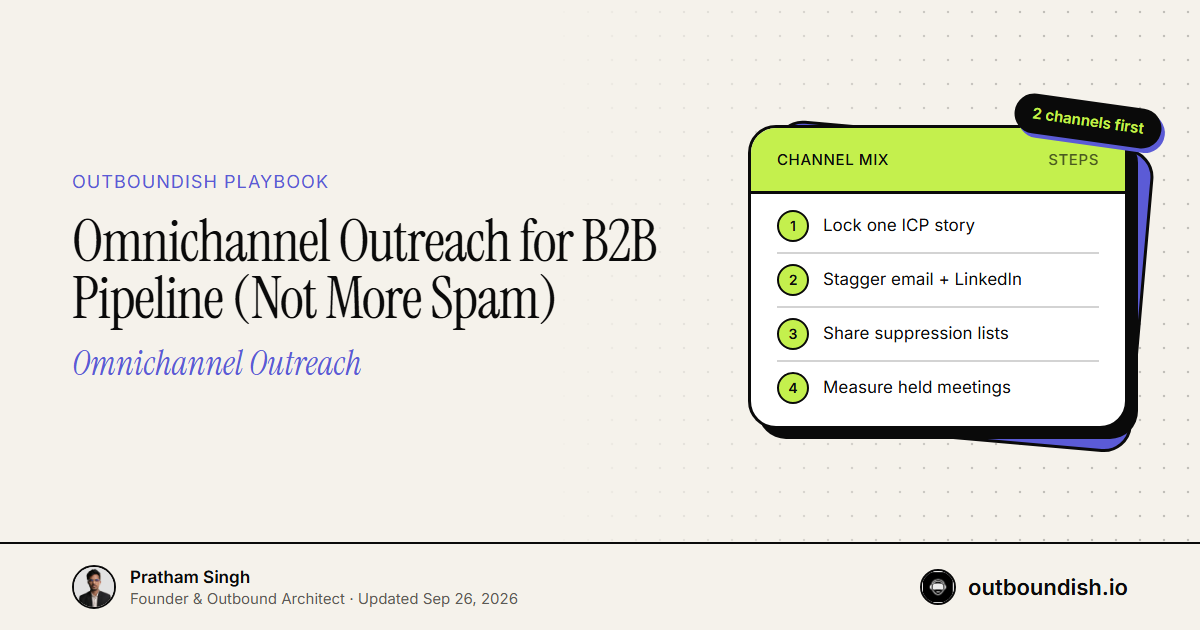
Real omnichannel outreach is one ICP, one offer story, multiple touches that each add context—not duplicate noise. Outboundish runs email + LinkedIn as a coordinated system inside $1k–$2k/mo pods aimed at ~$100–$150 per held meeting. More channels only help if show rate and reply quality improve.
What Omnichannel Means in B2B Outbound
| Channel | Job | Abuse mode |
|---|---|---|
| Cold email | Scalable reach | Burned domains, weak offers |
| Trust + multi-thread | Connection spam, bot DMs | |
| Phone / voicemail | Urgency for high ACV | Random dialing with no context |
| Content / social proof | Soft familiarity | Engagement cosplay without asks |
| Signals | Timing | Creepy openers, bad ICP still loses |
The motion fails when every channel runs a different ICP or a different promise. Align the story first. If email promises a teardown and LinkedIn pitches a product tour, you trained the buyer to distrust both.
Cadence Design That Does Not Feel Like Harassment
A simple B2B pattern that works for many mid-market motions:
| Day | ||
|---|---|---|
| 1 | Personalized open | Connection request |
| 3 | Proof / peer bump | — |
| 5 | — | Short DM if connected |
| 8 | Cost-of-inaction | Light relevant engage (optional) |
| 12 | Multi-thread email | Second-role connection |
| 15+ | Breakup / loop | Soft bump or stop |
That is choreography, not volume theater. Spacing matters. Identical copy pasted across channels is how you train people to ignore you. Reference prior touches lightly ("sent a note Tuesday on deliverability") so the thread feels continuous.
Rules That Keep You Adult
- One primary ask across the sequence (meeting / diagnostic)—not five CTAs
- Shared suppression — opt-out on email stops LinkedIn pitching the same person
- Trigger before volume — hiring, funding, stack change can reorder priority; they do not excuse bad ICP
- Reply SLA — positives get a human in minutes/hours during business time
- Held definition — booked ≠ held; reminders and tight windows belong in the system
If your "omnichannel platform" cannot enforce suppression and ownership, you bought a toy. Also decide who owns the CRM source field when a prospect replies on LinkedIn after an email. Ambiguity here creates double-booking and missed follow-ups.
Metrics Worth Tracking
| Metric | Why |
|---|---|
| Positive reply rate by channel | Shows which lane earns attention |
| Meetings by first-touch channel | Attribution honesty |
| Show rate | Protects AE time |
| Opportunity rate from held | Proves revenue path |
| Domain / LinkedIn health | Survival metrics |
Vanity opens and profile views are not success. Pipeline is. Review weekly which channel started the conversation versus which channel closed the booking—those are different jobs.
When Extra Channels Hurt
Add phone or InMail only when ACV and buying committees justify the cost and the base email+LinkedIn motion already converts. Pouring more channels on a broken ICP just multiplies waste. Fix list quality and offer before you buy another seat.
Teams that "go omnichannel" after a deliverability crash often make it worse—they move the same bad copy onto LinkedIn while domains recover. Pause. Repair. Then reintroduce channels with caps. A two-week cool-down with verification and offer rewrite beats a panicked multi-channel blast.
Ops Details Most Decks Skip
- Timezone-aware send windows so you are not pinging EU buyers at midnight local
- Role-based branching (champion vs economic buyer) instead of one generic path
- Breakup language that leaves the door open without guilt
- A written stop rule after N touches with no engagement
Those boring details are what separate professional omnichannel outreach from tool-stack cosplay.
Build vs Buy
Build when you have a manager who can own sequencing, deliverability, and coaching. Buy when founders should stay in product and closing. Hybrid is common: agency volume + internal close, with clear handoff fields in the CRM.
Price managed omnichannel outreach against held meetings (~$100–$150) inside a $1k–$2k/mo band—not against "touches per account." Touches are inputs. Held conversations are outputs.
Bottom Line
Treat omnichannel outreach as coordinated relevance across email and LinkedIn (plus other lanes only when earned). Same ICP, same story, staggered touches, shared suppression, fast replies, held-meeting math. Anything else is multi-channel spam with a prettier dashboard.
People Also Ask
It is coordinating multiple channels—usually cold email and LinkedIn, sometimes phone—around one ICP and offer so each touch adds context instead of repeating the same pitch.
Often for mid-market and up, because LinkedIn adds trust and multi-threading while email adds volume. It is worse if channels are uncoordinated or ICP is weak.
Start with email + LinkedIn done well. Add phone or paid InMail only when ACV and committee complexity justify it and the base motion already books held meetings.
Lean managed programs commonly run $1k–$2k/mo. Judge success near $100–$150 per held meeting when show rates and ICP fit hold—not by raw multi-channel touch counts.