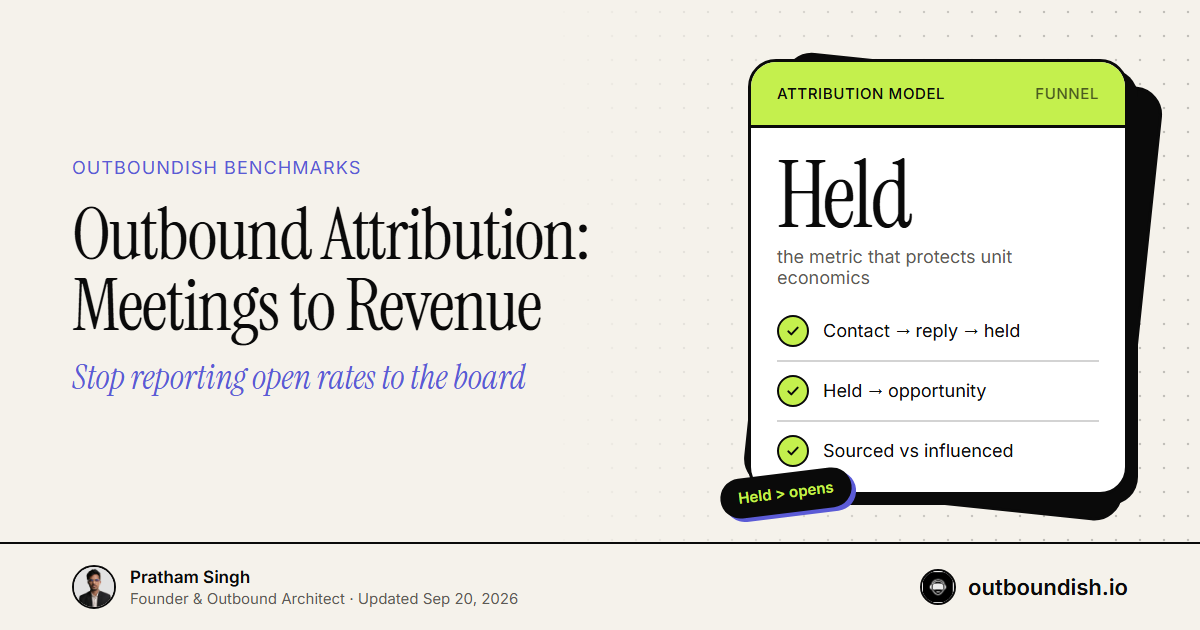
If leadership still asks whether outbound “works,” you probably report the wrong numbers. Opens and replies are diagnostics. Attribution is a chain from contacts to held meetings to opportunities to revenue that a CFO can audit.
The metric ladder
| Stage | Definition | Owner |
|---|---|---|
| Contacts reached | Unique people emailed/connected in period | Ops / SDR |
| Replies (human) | Non-auto human responses | Ops |
| Positive replies | Interest / curiosity / timing openness | Ops |
| Booked meetings | Calendar events created | Ops |
| Held meetings | Prospect attended | Ops + AE |
| Opportunities | Pipeline records created from those meetings | AE / RevOps |
| Sourced revenue | Closed-won credited to outbound | RevOps |
Open rate does not appear. For unit economics of held meetings, see Cost per Qualified B2B Sales Meeting Benchmarks.
Sourced vs influenced
| Model | Use when |
|---|---|
| Sourced | Outbound created the first meaningful sales conversation / opportunity |
| Influenced | Outbound touched an account that also had inbound/other touches |
Pick one primary model for team goals. Report the other as secondary. Mixing them in one KPI without labels starts political wars.
Account-level rollups matter in B2B: multiple contacts, one company. Credit the account journey, not a single email open.
Minimum CRM fields
Without these, attribution is fan fiction:
- Outbound campaign / sequence ID
- Channel (email, LinkedIn, omnichannel)
- SDR / operator owner
- Meeting disposition: booked / held / no-show / canceled
- Opportunity source = Outbound (or Influence flag)
- Created timestamps that survive handoffs
For make-vs-buy context on who should own this machine, see In-House SDR vs Outbound Agency Cost Breakdown.
A simple weekly scoreboard
| KPI | Why |
|---|---|
| Held meetings | Primary throughput |
| Show rate (held ÷ booked) | Calendar quality |
| Positive → held % | Inbox conversion |
| Held → opportunity % | AE acceptance / fit |
| Pipeline $ sourced | Commercial output |
If you pay an agency on meetings, contract language should say held and ICP-fit—see Agency Pricing Models.
How agencies should be held accountable
Good outbound partners accept:
- Clear ICP definition
- Held-meeting SLAs
- Visible bounce/complaint constraints
- Shared CRM truth
Vanity dashboards without held meetings are not accountability.
For CRM attribution concepts in mainstream platforms, start from vendor documentation such as HubSpot’s reporting/attribution guides (verify the current docs when you implement)—the principle is the same: define stages before you debate credit.
Bottom line
Define held. Instrument the ladder. Separate sourced from influenced. Report weekly. Then decide whether to scale domains—or fix the offer.
People Also Ask
The system that credits outbound activities for held meetings, opportunities, and revenue in a way that can be audited in the CRM.
Sourced means outbound created the opportunity path. Influenced means outbound touched a deal that also had other channels involved.
Held meetings, show rate, positive-to-held conversion, opportunity creation, and sourced revenue.
A held meeting means the prospect attended the scheduled conversation. Booked-but-absent should be no-shows, not wins.