Hiring an outbound lead generation agency feels safer than hiring SDRs—until you realize most firms sell activity theater. Pretty Loom kickoffs. Shared inboxes. "Meetings" with people who cannot buy. Your brand gets associated with spam, your domains burn, and your AEs learn to ignore the calendar.
The Brutal Truth
A real outbound lead generation agency owns targeting, infrastructure, messaging, and reply conversion. Outboundish sits in that category: cold email + LinkedIn, $1k–$2k/mo retainers, and economics aimed at $100–$150 per held meeting. The label "agency" is meaningless without those guts.
Agency vs Freelancer vs In-House
| Option | Strength | Weakness |
|---|---|---|
| In-house SDR | Brand control, learning stays internal | Ramp, management load, infra skill gap |
| Freelancer | Cheap flexibility | Bus factor, weak deliverability depth |
| Outbound lead generation agency | Systems + speed | Quality variance; needs tight SLA |
| Hybrid | Agency volume + internal close | Requires clear handoff rules |
Outbound lead generation companies that win long-term look more like ops partners than creative shops. They talk domains, bounce rates, show rates, and CRM fields—not "brand storytelling for cold outreach."
What Separates Serious Firms
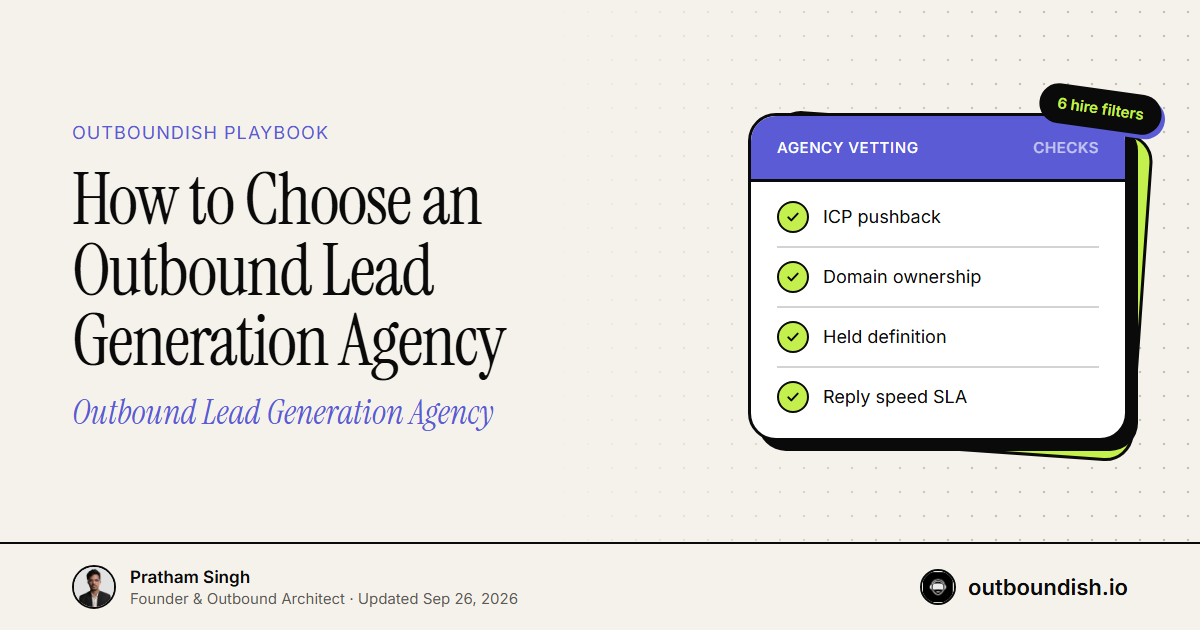
Evaluate any outbound lead generation agency on six axes:
- ICP discipline — Can they refuse bad accounts?
- Infrastructure — Separate domains, caps, monitoring
- Copy craft — Short, specific, non-slop
- Omnichannel — Email + LinkedIn with sane limits
- Reply SLA — Minutes/hours, not "next business day maybe"
- Held-meeting honesty — Booked ≠ held
Ask outbound lead generation companies for a redacted weekly report. If the only charts are open rates, walk.
Red Flags in Sales Decks
- Guaranteed meeting counts with no ICP gate
- "Unlimited sends" as a feature
- Using your primary corporate domain for cold
- Offshore copy factories with no QA
- Case studies with logos but no methodology
- Pricing so low the only margin is spray volume
Serious outbound lead generation companies will push back on bad ICPs. That friction is a feature.
Contracting Without Getting Burned
Put this in the SOW:
- ICP definition + exclusions
- Channels in scope
- Held-meeting definition and qualification checklist
- Ramp timeline and volume assumptions
- Deliverability ownership and pause rules
- Weekly reporting fields
- Termination if quality collapses
Optional: pilot 45 days before annual commitment. Outboundish-style pilots often land in the $900–$2k band depending on scope—still cheaper than a bad full-time hire who quits at month four.
How Agencies Should Work With Your Team
| Role | Agency owns | You own |
|---|---|---|
| List + enrichment | Primary build + QA | ICP truth, disqualifiers |
| Messaging | Drafts + tests | Product proof, objections |
| Meetings | Booking + reminders | AE show-up + notes |
| CRM | Source fields, outcomes | Pipeline stages, close data |
An outbound lead generation agency that refuses feedback loops will drift into generic volume. Weekly 30-minute reviews beat monthly "performance decks."
When Not to Hire
Do not hire if:
- You have no idea who buys or why
- ACV cannot support ~$100–$150 per held meeting
- Nobody on your side will take meetings or reply to positives
- You want the agency to invent product-market fit
Outbound amplifies clarity. It does not create it.
Proof You Should Ask For
Before you sign, request a redacted sequence, a domain plan summary, and two examples of how they handled a deliverability dip. Ask how they define ICP fit on a booked meeting and what happens when an AE marks a lead unqualified. Outbound lead generation companies that dodge those questions usually optimize for calendar volume over revenue path.
Also clarify tooling ownership: who pays for data, sequencers, and LinkedIn seats, and what you keep if you leave. Ambiguity here creates hostage situations later.
Bottom Line
Choose an outbound lead generation agency the way you choose a production vendor: inspect the system, not the slogan. Prefer outbound lead generation companies that obsess over held meetings, protect domains, and tell you no when the list is wrong. Everything else is expensive noise with a Slack channel.
People Also Ask
It builds and runs cold outbound systems—usually email and LinkedIn—to book qualified conversations with ICP buyers, including list work, infrastructure, copy, sequencing, and reply handling.
Ask for ICP filters, domain strategy, sample copy, held-meeting definitions, reply SLAs, and a sample report. Avoid vendors who lead with open rates or unlimited send promises.
In-house wins when you can coach and wait through ramp. An agency wins when you need faster capacity and do not want to own deliverability engineering. Many teams run hybrid.
Expect roughly $1k–$2k/mo for a lean managed program, with unit economics near $100–$150 per held meeting when quality holds. Ultra-cheap retainers usually trade away infrastructure and ICP discipline.