Searching outbound lead generation companies feels like scrolling the same deck with different logos. Everyone promises “qualified meetings.” Few define held. Fewer show domain discipline. Your job is not to collect proposals—it is to run a scorecard that fires weak vendors before they burn your brand.
Outboundish is one of those companies: cold email + LinkedIn, retainers typically $1k–$2k/mo, economics framed around $100–$150 per held meeting. Use that band as a sanity check, not a religion. Cheap volume that wastes AE time is expensive.
What “company” should mean in this category
Outbound lead generation companies are not the same as list brokers or sequencer resellers. You want an operator that owns:
| Capability | Proof to demand |
|---|---|
| ICP design | Exclusions + sample accounts |
| Infrastructure | Secondary domains, caps, kill switches |
| Messaging | Real sequences, not AI paragraphs |
| Multi-channel | Email + LinkedIn (or a justified single channel) |
| Reply handling | Named owner + speed SLA |
| Reporting | Held meetings → opportunities |
If they only sell enrichment CSVs, they are a data vendor. Label them correctly. If they only rent sequencer seats, they are a tools shop. Neither replaces an outbound operator.
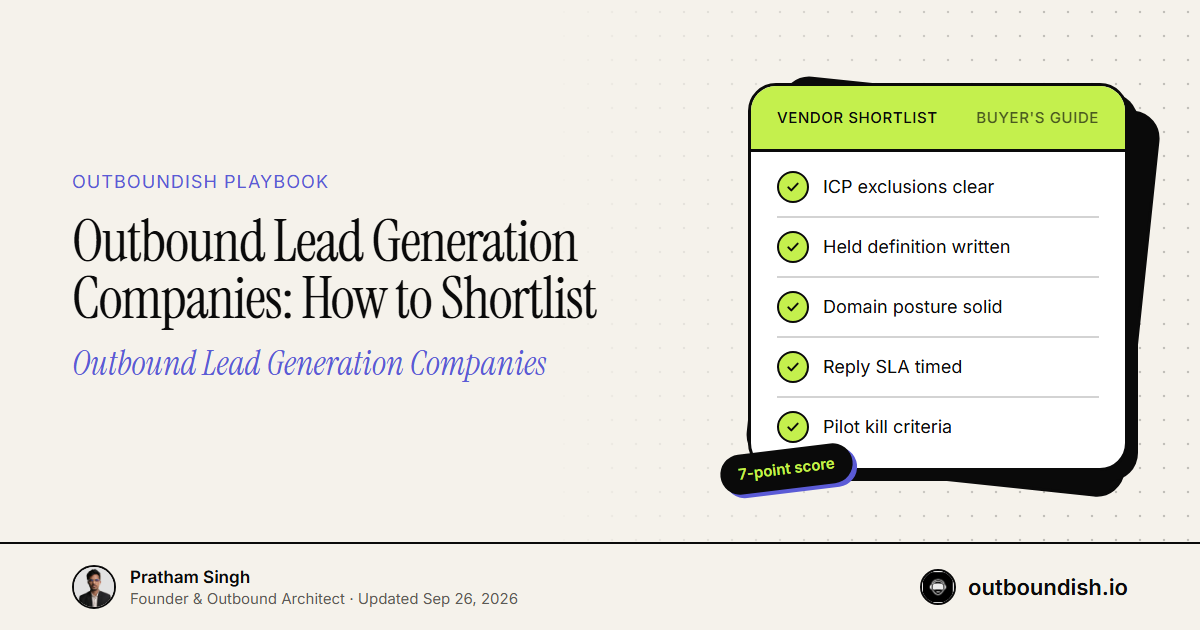
Scorecard for shortlisting outbound lead generation companies
- ICP sharpness — Can they show who they will never touch?
- Deliverability posture — Primary domain off-limits; portfolio math documented.
- Held definition — Written. No-show and reschedule rules included.
- Reply SLA — Minutes, not “we try our best.”
- Channel honesty — When email stalls, do they add LinkedIn—or buy more sends?
- Reporting — Sourced vs influenced; no open-rate theater.
- Exit terms — Pause/kill when quality or reputation dips.
Compare market options with Best B2B Outbound Agencies Comparison and the build-vs-buy math in Hire SDR vs Outbound Agency.
Run the scorecard live on the sales call. Vendors who scramble deserve a polite no.
Pricing patterns that survive diligence
| Model | Fit | Watch-out |
|---|---|---|
| Monthly retainer | Always-on system | Vague deliverables |
| Pilot (30–45 days) | Prove channel fit | Scope domains + segments |
| Hybrid + performance | Shared upside | Define held tightly |
| Pure pay-per-meeting | Variable cost | Soft bookings inflate “wins” |
Healthy outbound lead generation companies can explain why $1k–$2k/mo buys capacity and why $100–$150/held is the unit test—not why they need six months before any calendar activity. Cost depth: In-House SDR vs Agency Costs.
Ask what is included in month one: domains, list QA, copy tests, CRM fields. Vague “onboarding” is where weak scopes hide.
Red flags
- Guaranteed meeting quotas with no ICP boundaries
- Sending from your corporate domain
- “AI personalization” with zero human QA samples
- Reporting that stops at opens/clicks
- No written pause rules when deliverability dips
- Junior-only pods with no senior review on positives
- Contracts that lock you in after a bad list week
How to run a clean vendor pilot
Pick one ICP wedge. Cap daily volume. Define held criteria up front. Review reply quality weekly. Expand only after positive→held and show rates look durable. Demand loom reviews of live threads, not monthly PDF vanity.
Ask outbound lead generation companies for three anonymized reply examples from the last 30 days. Operators who live in the work can share them. Slide-deck companies stall. Also ask who pauses a domain when hard bounces spike—and whether that person has authority to stop sends without a committee.
In-house vs company vs hybrid
Hire in-house when you have managers and ramp time. Buy a company when you need speed-to-system. Hybrid often wins: external pod stands up infrastructure and tests; internal AE owns late-stage conversion. Revisit the split every quarter based on held-meeting unit economics—not vibes.
If you already have SDRs, some vendors will run infrastructure + copy while your team owns replies. That can work—if ownership lines are written down.
Bottom line
Shortlist outbound lead generation companies like production vendors: scorecard, pilot, kill criteria. Pay for held meetings and reputation safety. Ignore logos that cannot explain domains, reply ownership, and what happens when metrics go red.
People Also Ask
Use a written scorecard: ICP exclusions, domain posture, held-meeting definition, reply SLA, channel mix, CRM reporting, and exit rules. Ignore decks that only show logos.
Serious managed outbound often lands around $1k–$2k/mo. Effective cost should be judged near $100–$150 per held meeting when ICP and show rates are healthy.
Hire when you can manage ramp. Buy a company for speed-to-system. Hybrid is common: external top-of-funnel, internal closing ownership.
Guaranteed meetings without ICP boundaries, or sending cold volume from your primary corporate domain. Both destroy trust and deliverability.