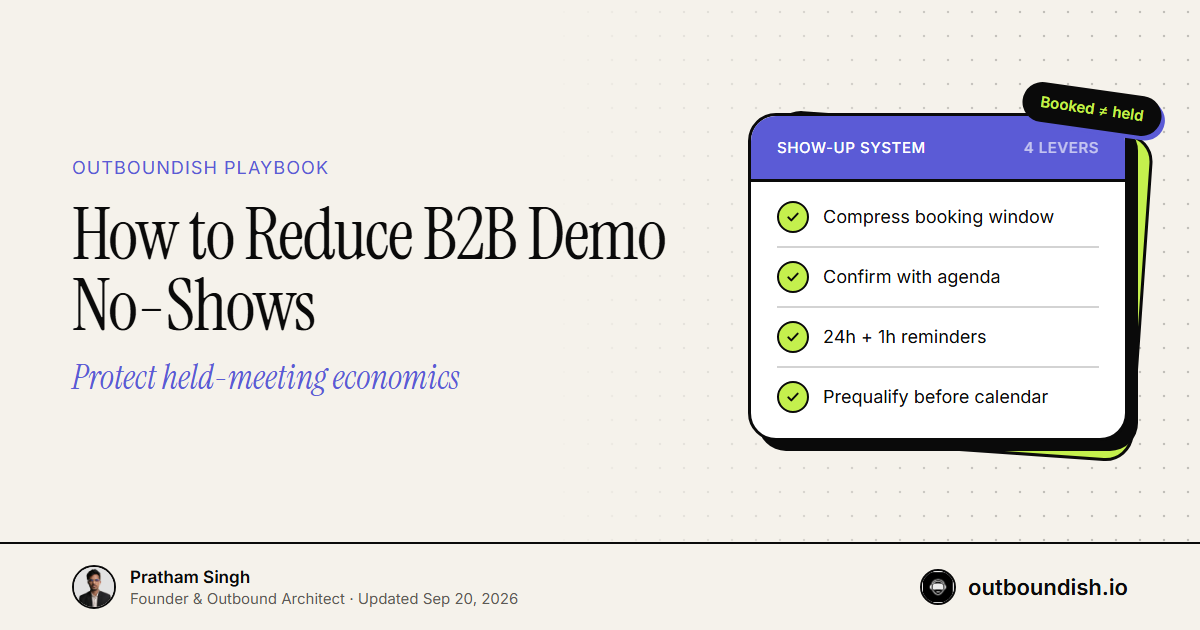
Booked meetings are vanity if they do not become held meetings. Outbound unit economics—especially agency pricing around $100–$150 per held meeting—collapse when show rates are ignored. Fix the calendar system, not just the sequence.
Booked vs held (define it)
| Term | Meaning |
|---|---|
| Booked | A calendar event was created |
| Held | Prospect attended and the conversation happened |
| No-show | Prospect did not attend without a timely reschedule |
| Cancel / reschedule | Prospect changed plans before start |
If your CRM counts “meetings” as booked, your outbound looks healthier than it is. For pricing context, see B2B Lead Gen Agency Pricing Models and Cost per Qualified Sales Meeting Benchmarks.
Why outbound no-shows run hot
Cold-booked meetings start with lower commitment than inbound demos. Interest was created by outreach, not by the prospect hunting you. Public scheduling benchmarks repeatedly show longer booking windows → worse show rates, and cold-booked channels often underperform referral/inbound show rates. Use published studies as framing; measure your own baseline for 30 days before celebrating a “fix.”
Lever 1: Compress the booking window
Same-day and next-day slots consistently beat meetings booked a week or more out in industry scheduling research. For outbound positives:
- Offer 2–3 concrete times in-thread
- Prefer ≤3 days out when possible
- Avoid 14–30 day open calendars for cold interest
Speed protects intent.
Lever 2: Confirm with an agenda (not “just checking in”)
Within minutes of booking, send:
- What you will cover
- What you need from them (role, stack, timeline)
- Join link
- How to reschedule
A confirmation is a commitment device. A bare calendar invite is not.
Lever 3: Reminder cadence that earns attention
| Timing | Channel | Job |
|---|---|---|
| 24 hours before | Agenda + value reminder + link | |
| 1 hour before | Email/SMS (where appropriate) | Short resurfacing + link |
| Optional 15 min | Calendar notification | Last nudge |
Reminders work best after you already compressed the window and confirmed value. They cannot rescue a low-intent booking from two weeks ago.
Lever 4: Prequalify before the calendar appears
Ask a few filters before unlocking the full calendar:
- Company size / segment
- Role fit
- Timing (“looking this quarter?”)
People unwilling to answer three questions often would not have shown up anyway. For booking mechanics that protect quality, see How to Book Qualified Demos with Outbound Outreach.
Tie it to money
If you book 40 meetings and 30% no-show, you paid for 12 empty slots. Raising show rate is often cheaper than buying more domains and more sends. Optimize for held ICP meetings.
Bottom line
Define held. Shorten the window. Confirm with agenda. Remind with purpose. Prequalify. Then scale volume.
People Also Ask
It varies by segment, but outbound cold-booked meetings typically show worse than inbound. Benchmark yourself for 30 days, then improve window length and confirmation quality.
They resurface the commitment and join link near the meeting. They work best with shorter booking windows and a value-led confirmation.
Yes for outbound. Light qualification filters low-intent curiosity and improves AE time quality.
Booked means a calendar event exists. Held means the prospect attended. Pricing and attribution should use held meetings whenever possible.