Follow-up cadence (working default)
| Touch | Day | Job of the email |
|---|---|---|
| 1 Opener | 0 | Relevance + one clear ask |
| 2 | 2–4 | New proof or angle (not “bumping”) |
| 3 | 6–9 | Risk reversal / micro-case |
| 4 | 12–16 | Breakup or alternative CTA |
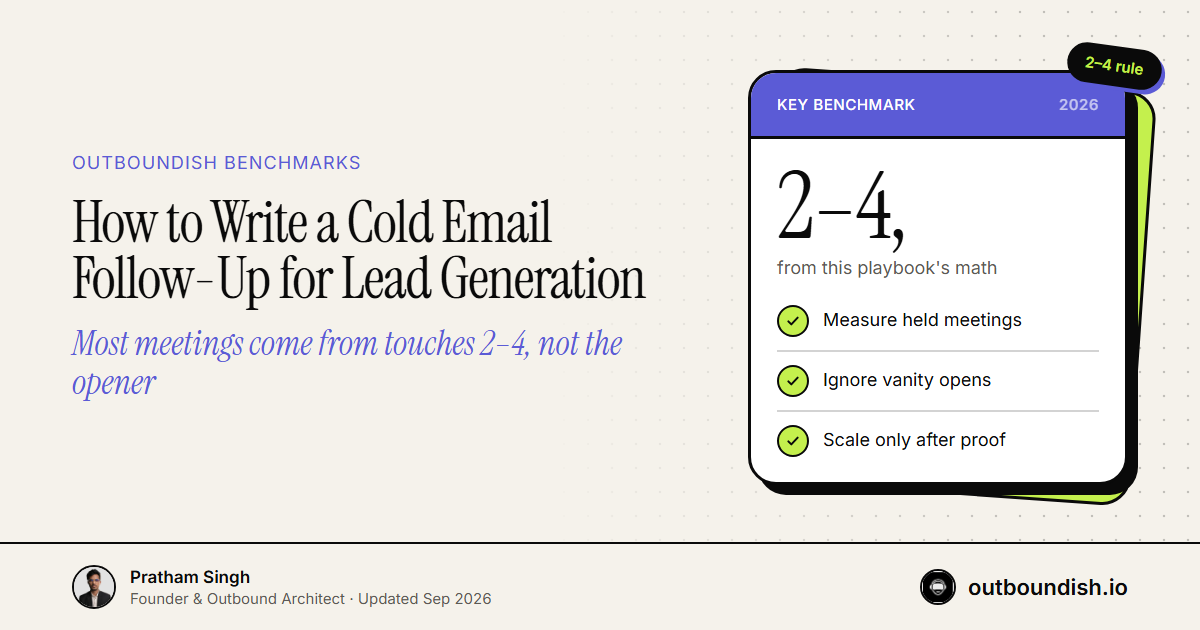
Most meetings come from touches 2–4, not the opener. Use 3–5 total emails over 14–21 days, change the angle each time, and stop before spam complaints climb.
The Fortune is in the Follow-Up
This is where 90% of salespeople drop the ball. They send one brilliant cold email, wait two days, send a weak "just checking in" message, and then quit. They assume the prospect isn't interested.
In B2B enterprise sales, silence rarely means "no." It usually means "I am too busy right now." If you quit after 3 emails, you are leaving massive amounts of revenue on the table.
The 15-Touch System
A true lead generation machine builds sequences up to 15 touches deep. Deals are frequently closed on the 7th, 10th, or even the 14th email. Persistence proves professionalism.
How to Follow Up Without Being Annoying
You cannot simply bump the thread 15 times. Every follow-up must shift the angle or add a micro-piece of value.
- The Referral Ask: "Would you be willing to do me a quick favor? Who on your team handles the outbound infrastructure?"
- The Visual Proof: Reply to your own email with a screenshot of a recent success metric or a brief case study.
- The Breakup: Acknowledge the silence. "I assume scaling this isn't a priority right now. Feel free to reach out if things change." This soft break-up often triggers replies from prospects who don't want to lose the option.
Follow-up copy rules that do not sound desperate
- Never send “just bumping this” with no new information.
- Each touch should add proof, a sharper question, or a smaller ask.
- Keep the total thread short enough to read on a phone.
- Stop when complaints rise or the ICP clearly does not care—volume is not a personality trait.
Persistence is a strategy only when every follow-up earns the next second of attention.
Follow-up math founders ignore
If your opener reply rate is 1–2%, follow-ups are not optional—they are where a large share of meetings appear. The constraint is relevance per touch, not stubbornness.
- Plan 3–5 total emails across 14–21 days.
- Change the angle each time (proof, risk, sharper question).
- Track held meetings by touch number, not opens.
- Stop when complaint or unsubscribe rates rise for that segment.
Want dedicated secondary inboxes, multi-pool mailbox rotation, and guaranteed primary placement managed for your team? Explore how our done-for-you cold email agency infrastructure pods run outbound without risking your domain portfolio.
Compliance Framework: Ensure follow-up messages include compliant opt-out mechanisms under the FTC CAN-SPAM Act Compliance Guide for Business.
People Also Ask
Change the angle: proof, a sharper question, a referral ask, or a breakup—not “just checking in.” Silence usually means busy, not no. Identical bumps train them to ignore you.
Reps assume no reply equals no interest and quit. A large share of held meetings come from touches 2–4 over 14–21 days, not the opener.
Not as 15 copies of the same pitch. Three to five email touches plus LinkedIn is enough for most ICPs. Past that, spam complaints rise while reply rates flatten unless each touch is a new asset.
After you have added new information and still have silence. A clean “I’ll close the file” often triggers people who were interested but delayed. Then stop.