Most b2b lead generation lists are expensive junk food: big row counts, pretty titles, and bounce rates that punish your domains. Founders buy a CSV, load a sequencer, and declare outbound "dead" when the real problem was the list.
The Brutal Truth
Outboundish treats list quality as infrastructure. Our cold email + LinkedIn programs run around $1k–$2k/mo with targets near $100–$150 per held meeting. That math collapses if half the emails are wrong roles or dead addresses.
What a Usable List Is
A usable row is not "a person with an email." It is:
- Company matches ICP firmographics
- Persona matches buying role (or clear influencer path)
- Contact data verified recently
- Exclusion rules applied (customers, competitors, students, partners)
- Source tagged for debugging
| List type | Looks good | Usually books meetings? |
|---|---|---|
| Raw scraped CSV | Huge volume | Rarely |
| Enrichment-only dump | Fancy columns | Only with human QA |
| Intent-scored inbound export | Warm labels | Better if sales-ready |
| ICP-built + verified outbound list | Smaller | Highest path to held meetings |
| Event / community list | Context | Good if follow-up is fast |
Serious b2b lead generation lists are built, not bought once and forgotten.
Build Process That Survives Contact With Reality
- Scorecard first — firmographics, persona, triggers, exclusions
- Account universe — companies worth a touch this quarter
- Contact find — roles that can champion or buy
- Verify — email validation + spot-check titles
- Enrich signals — hiring, tech, funding only after ICP passes
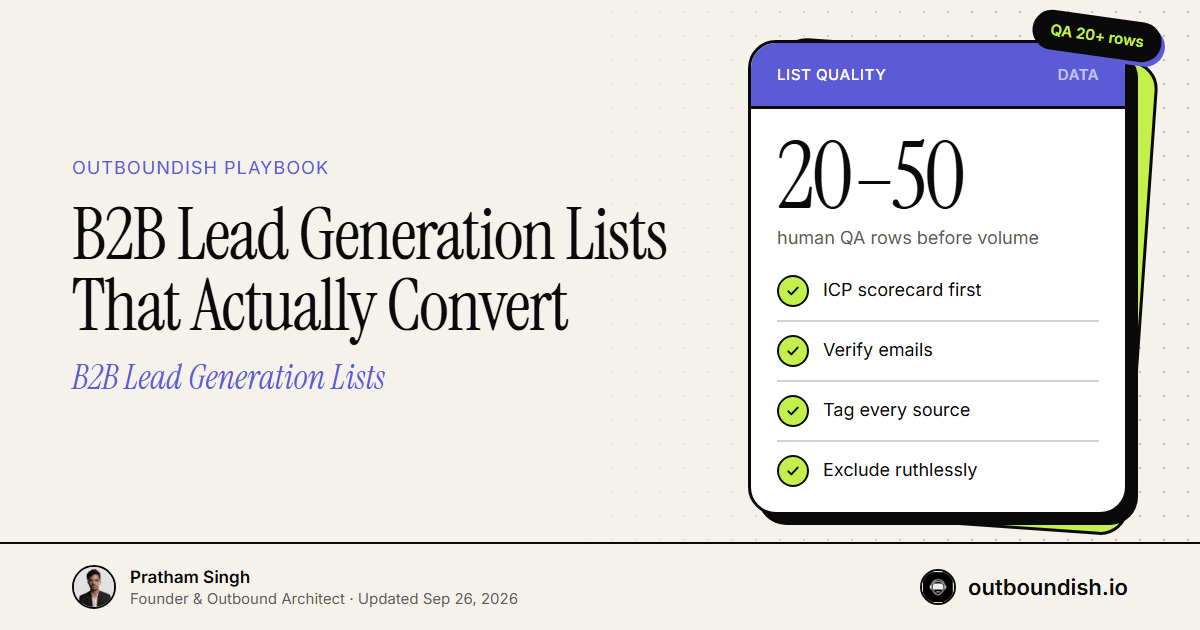
- QA sample — humans review 20–50 rows before volume
- Suppress — bounce, opt-out, do-not-contact across tools
Skip QA and you will "optimize copy" for weeks while the real leak is title accuracy. That is how teams waste sequencers.
Bought Lists vs Built Lists
Bought b2b lead generation lists can seed research. They should not be the production send file without filters and verification. Vendors sell freshness theater. Your domains pay the invoice when emails die.
Built lists cost more upfront time. They win on reply quality and deliverability. If you outsource building, demand sample rows, bounce expectations, and a redo clause when quality slips.
Data Fields That Matter More Than You Think
| Field | Why |
|---|---|
| Seniority + function | Stops student / wrong-dept spam |
| Direct dial / email confidence | Protects send reputation |
| LinkedIn URL | Enables multi-channel and title QA |
| Source + pull date | Debugging and freshness |
| Exclusion reason | Stops repeat mistakes |
If your b2b lead generation lists lack source and pull date, you cannot debug a bounce spike. You can only panic.
Common Failure Modes
- TAM cosplay: "10,000 accounts" with no ACV fit
- Persona mush: "marketing or sales or ops"
- Recycling the same file quarterly without re-verify
- Mixing countries and compliance postures in one sequence
- Celebrating list size in Slack instead of positive-reply rate
Fix the definition of done: a list is done when a QA sample passes, not when Clay finished running. Also watch for "personalization columns" that are empty or nonsense—tools love inventing company news that never happened.
How Lists Tie to Unit Economics
Backsolve held meetings → booked → positives → sends. Then ask whether your list can support that volume at acceptable bounce and positive rates. Scaling bad files just accelerates domain burn.
Agencies that refuse to show list samples are selling mystery meat. Ask for 25 anonymized rows and a verification method before you celebrate "pipeline capacity." Demand a redo if bounce exceeds the band they promised in writing.
Weekly List Hygiene
Treat the send file like inventory:
- Pull new ICP accounts on a schedule; do not live forever on one export
- Re-check titles for long-running sequences
- Suppress hard bounces and role changes immediately
- Separate experiments (new persona) from production lists so you can attribute results
Teams that skip hygiene eventually "fix deliverability" while still feeding the sequencer garbage. Infrastructure cannot save a rotten contact file. If bounce spikes, pause sends first—then audit the last 100 rows before you buy another warmup tool.
Bottom Line
Treat b2b lead generation lists as a product with QA, freshness, and exclusions—not a one-time purchase. Build from ICP, verify, tag sources, and measure against held meetings. Cheap rows are expensive when AEs and domains pay the price. If you want a managed build+send motion, keep pricing honest: $1k–$2k/mo and roughly $100–$150 per held meeting when the list is adult.
People Also Ask
ICP fit, correct personas, recent verification, clear exclusions, and source tags—plus a human QA sample before you send at volume.
As a research seed, sometimes. As a production send file without filters and verification, usually not. Bought volume often taxes deliverability more than it creates meetings.
Re-verify before major campaigns and on a recurring cadence for evergreen segments. People change jobs; stale emails burn domains quietly.
Provenance, verification method, expected bounce bands, exclusion logic, sample rows, and what happens when quality fails. Vague answers mean spray.