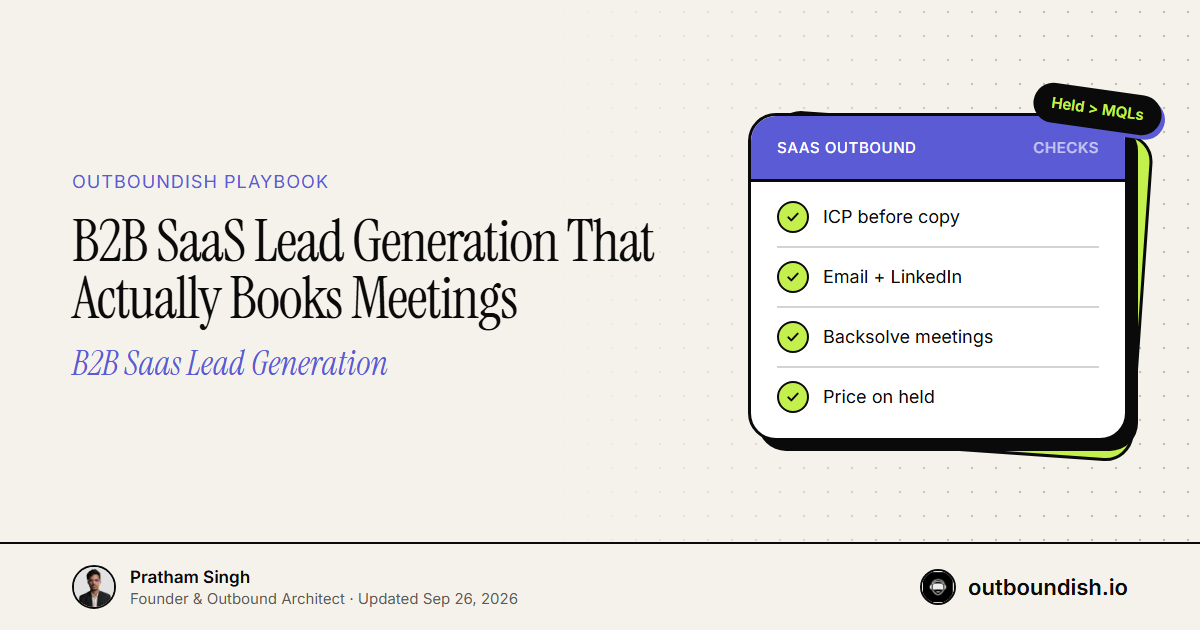
Most "b2b saas lead generation" programs are inbound cosplay: gated PDFs, webinar lists, and SDR dialers burning through scraped emails. Founders then wonder why pipeline is empty while marketing celebrates MQLs. If your ACV supports outbound and your ICP is findable, you do not need more content volume—you need a system that puts directors and VPs on calendar.
The Brutal Truth
Outboundish runs cold email + LinkedIn for B2B SaaS teams that want held meetings, not vanity opens. Pricing sits at $1k–$2k/mo with unit economics around $100–$150 per held meeting. That only works when ICP, offer, and infrastructure are honest.
What Good Lead Gen Means for SaaS
For SaaS, b2b saas lead generation is not a form fill. A usable lead is a person at a company that matches ICP, with a problem your product solves, who agreed to a live conversation. Everything else is noise.
| Asset type | Looks productive | Usually converts? |
|---|---|---|
| Ebook / webinar MQL | High volume | Rarely without heavy nurture |
| Intent-scored inbound | Medium | Better if sales-ready |
| Outbound held meeting | Lower volume | Highest close path for mid-market+ |
| Partner intro | Low volume | High trust, hard to scale |
If your sales cycle needs a champion and a budget owner, prioritize meetings over list growth. That is the entire thesis of serious b2b saas lead generation.
The Outbound Math (Backsolve Meetings)
Start from held meetings, not send volume.
- Target held meetings / month (example: 20).
- Show rate (example: 70%) → booked needed ≈ 29.
- Positive-reply → booked conversion (example: 35%) → positives needed ≈ 83.
- Positive rate on cold (example: 1.5%) → sends needed ≈ 5,500 / month.
That send volume is infrastructure work (domains, mailboxes, LinkedIn seats)—not "hire one junior and hope." Teams that skip the math buy tools and blame the channel.
Channel Mix for B2B SaaS Leads
Cold email scales volume. LinkedIn builds trust and multi-threads. Use both.
| Channel | Job | Failure mode |
|---|---|---|
| Cold email | Reach + volume | Burned domains, weak offer |
| Trust + multi-thread | Automation bans, soft pitches | |
| Signal enrichment | Timing | Noise if ICP is wrong |
| AE follow-up | Close path | Slow replies kill intent |
When we say we generate b2b saas leads, we mean ICP-fit meetings with a defined SLA—not "interested" replies that ghost. Treat b2b saas leads as a pipeline asset with a show-rate and opportunity conversion attached.
ICP Before Copy
Copy cannot fix a bad list. Score accounts on:
- Firmographics (size, segment, tech signals that match your wins)
- Trigger (hiring, funding, stack change, competitor churn)
- Exclusion (students, agencies pretending to be buyers, existing customers)
If you cannot name who should never get a touch, you do not have an ICP. You have a hope list. Soft ICP is why spray campaigns look busy and produce zero pipeline.
Offer and Message
Lead with a sharp problem and proof, not your feature list.
- One-sentence problem your best customers had before buying
- One proof point (peer logo, metric, or before/after)
- One clear ask (15-minute diagnostic or demo with a reason)
Four-line emails beat novels. LinkedIn notes should reference the email or a real trigger—not "loved your post."
Ops That Protect Unit Economics
- Price and report on held meetings, not booked-only
- Confirm agendas within minutes of booking
- Compress booking windows; long tails raise no-shows
- Route hot replies in under 30 minutes during business hours
Agencies that sell "leads" without a held definition are selling screenshots. If you buy or build b2b saas lead generation capacity, demand the same discipline you would demand from an AE: ICP, SLA, and CRM truth.
When to Buy vs Build
Build in-house when you have a manager who can coach SDRs, own deliverability, and wait through ramp. Buy when you need speed, clean infrastructure, and a partner who already lives in the failure modes. Hybrid often wins: outsource top-of-funnel volume, keep closing internal.
Bottom Line
Treat b2b saas lead generation as a meeting factory with clear inputs and outputs. Nail ICP, run email + LinkedIn with adult infrastructure, and measure held meetings. Vanity MQLs do not pay payroll—conversations with buyers do.
People Also Ask
It is a system that finds ICP-fit accounts and books live conversations with buyers—usually via cold email and LinkedIn—not a pile of gated-content MQLs.
Backsolve from revenue. Many mid-market SaaS teams aim for a steady band of held meetings per month (often teens to low thirties) once infrastructure and ICP are stable—then scale volume only after show rate and opportunity conversion hold.
They solve different jobs. Inbound compounds brand; outbound creates controllable meeting volume when ICP is clear and ACV supports the cost per held meeting.
Serious retainers often land around $1k–$2k/mo with effective cost near $100–$150 per held meeting when ICP, show rate, and reply handling are tight. Cheap volume without a held SLA is usually more expensive after AE time is counted.