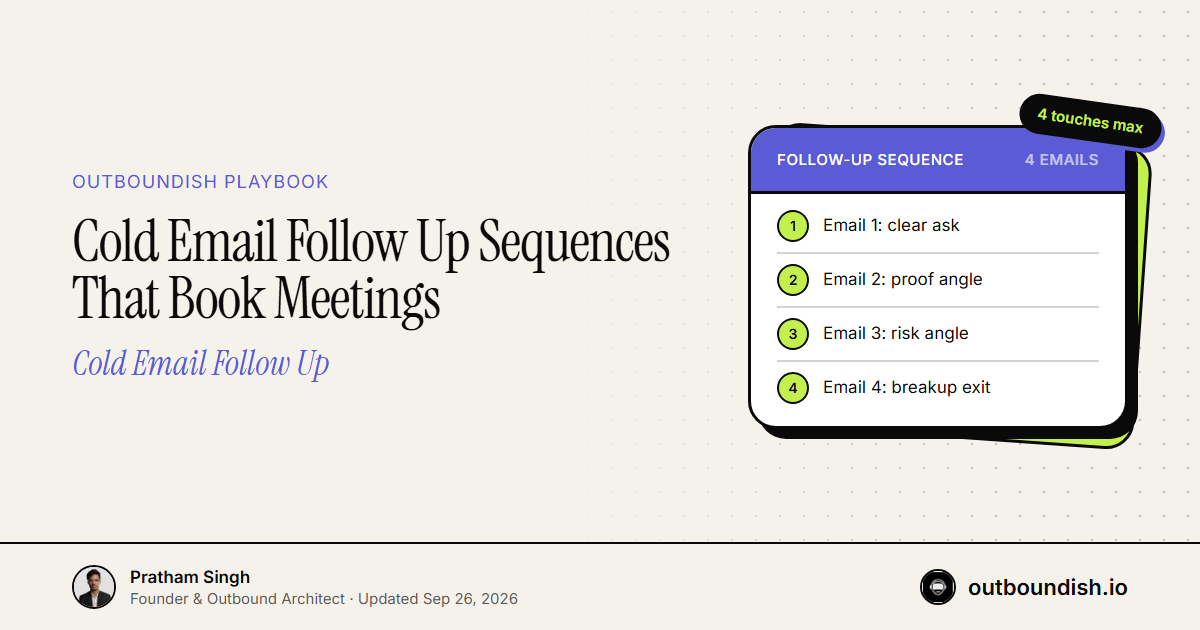
Most cold email follow up is just “bumping this.” That is not a sequence. That is a reminder that you had nothing new to say. A real follow-up system changes the angle, protects deliverability, and stops before you train the prospect to ignore you.
If email one was weak, email seven will not save it. Fix the offer first—then sequence.
Principles before templates
| Principle | Meaning |
|---|---|
| New value each touch | Proof, risk, alternate persona angle—not “checking in” |
| Short by default | 4–6 lines; one ask |
| Stop on reply | Any human reply kills the sequence |
| Cap the thread | Usually 3–5 emails total for cold |
| Pause > push | After breakup, wait; do not forever-nurture cold names |
Cold email follow up exists to create a second chance at relevance—not to harass inboxes.
A practical 4-email follow-up sequence
Assume email 1 already sent a clear observation + soft CTA.
Email 2 (Day 3–4) — Proof angle
One outcome pattern. One metric or before/after. One question. No attachment spam.
Email 3 (Day 7–8) — Risk / cost-of-inaction
What breaks if they wait a quarter? Keep it specific to their role (pipeline coverage, ramp time, CAC). Still one ask.
Email 4 (Day 12–14) — Breakup / permission close
Permission to close the loop. Paradoxically, honest breakups often earn the reply. Then stop.
| Job | Avoid | |
|---|---|---|
| 2 | Credibility | Repeating email 1 verbatim |
| 3 | Urgency without fake scarcity | “Final final notice” theater |
| 4 | Clean exit | Guilt trips |
For frameworks and phrasing patterns, pair with Cold Email Follow-Up Framework and Write Cold Email Follow-Ups. Keep copy in the 4-Line Cold Email Framework shape when you can.
Timing and sending hygiene
- Space touches across business days in the prospect’s timezone
- Do not stack five follow-ups inside a week on a cold lead
- Keep daily inbox caps conservative while sequences run
- If hard bounces rise, pause the campaign—do not “follow up harder”
Cold email follow up volume multiplies infrastructure load. Every extra step is another chance to bounce or complain.
Multichannel without chaos
Email-only sequences underperform when buyers live on LinkedIn. Light pattern: email 1 → LinkedIn view/connect → email 2 → soft bump → email 3 → breakup. The LinkedIn touch is familiarity, not a pitch dump in their DMs on day one.
What to do when they reply
Sequences end. Humans begin. Classify interest, hit speed-to-lead, propose times. That handoff is where meetings are won—see the positive-reply playbook on the site. Cold email follow up that books a curious reply and then waits two days is self-sabotage.
Metrics that matter
Track reply rate by step, positive rate, unsubscribe/complaint signals, and positive→held conversion. If step 3 always tanks sentiment, rewrite or remove it. More steps are not a strategy.
A simple weekly review for follow-up performance:
| Check | Action if red |
|---|---|
| Step 2 reply rate ≪ step 1 | Rewrite proof; do not add steps |
| Complaints up after step 3 | Soften urgency or cut the email |
| Positives with slow AE response | Fix routing before more sends |
| Breakup earns replies | Keep it; do not replace with another pitch |
Personalization that does not fake intimacy
One true detail beats five scraped trivia lines. Reference a trigger you can defend (hiring, stack, funding, public initiative). If you cannot defend it on a call, delete it. Cold email follow up that repeats hollow personalization just multiplies the cringe.
Commercial framing
If you outsource sequencing ops, expect $1k–$2k/mo for a real system and judge success near $100–$150 per held meeting. Paying for “more follow-ups” without ICP and reply handling just buys quieter domains.
Run a two-week test on one segment: four-touch max, human reply SLA under a business day, report held meetings only. If the sequence cannot clear that bar, the problem is offer or list—not missing email five.
Bottom line
Cold email follow up sequences should feel like a short series of distinct arguments—then a clean exit. Change the angle, respect the inbox, stop on reply, and measure held meetings. Bumps are laziness with a send button.
People Also Ask
Usually 3–5 total touches including the first email. Beyond that, reply quality rarely improves and complaint risk rises unless you have a strong reason to continue.
Common spacing is a few business days between early touches, stretching toward a week before a breakup. Exact timing depends on segment urgency—not a universal law.
No. Each touch should add proof, a new angle, or a clean exit. Empty bumps train prospects to ignore you and waste sending capacity.
Stop after a breakup email, any human reply, hard bounce, or clear unsubscribe/complaint signal. Stopping is part of professional outbound—not a failure.