The 2027 Strategic Shift
TL;DR: The Core 2027 Takeaways
- The Single-Database Trap: Relying on a single contact database (like Apollo or ZoomInfo alone) results in a 15–25% invalid data rate. High-performing teams use multi-vendor waterfall enrichment in Clay.
- The Catch-All Risk: Over 40% of enterprise B2B mailboxes are configured as catch-alls (accept-all). Traditional verifiers guess; specialized SMTP verification tools must ping mail servers directly.
- The Sub-1% Bounce Standard: Any cold email campaign with a bounce rate over 2% will rapidly degrade sender reputation. Rigorous waterfall scrubbing keeps bounce rates under 0.8%.
Why Contact Data Decides Outbound Success in 2027
You can write the most compelling sales copy on earth, but if 15% of your emails bounce and half of your messages reach outdated contacts who changed companies six months ago, your campaign will fail. In 2027, outbound sales is fundamentally a data engineering discipline.
Mailbox providers like Google and Microsoft monitor domain bounce rates in real time. If your campaign bounce rate exceeds 2%, your sending IP is immediately downgraded. Below is the blueprint modern outbound teams execute to maintain 85%+ contact match rates and sub-1% bounce rates.
The Flaw in Single-Database Scraping
Most novice sales development reps log into Apollo or ZoomInfo, apply basic industry and title filters, export 1,000 leads to a CSV, and immediately upload them into an email sequencer. Here is why that fails:
- Database Decay: Average annual employee turnover in B2B tech is roughly 25%. A database that updates quarterly contains hundreds of stale, deactivated email addresses.
- Catch-All Blind Spots: Up to 45% of enterprise companies configure their mail exchangers as "catch-all" (accept-all). Traditional scrapers mark these as "valid" even when the individual inbox does not exist.
- List Fatigue: When thousands of SDRs scrape the exact same Apollo database using identical keyword filters, those prospects receive dozens of generic pitches every week.
The Modern Waterfall Lead Enrichment Flow
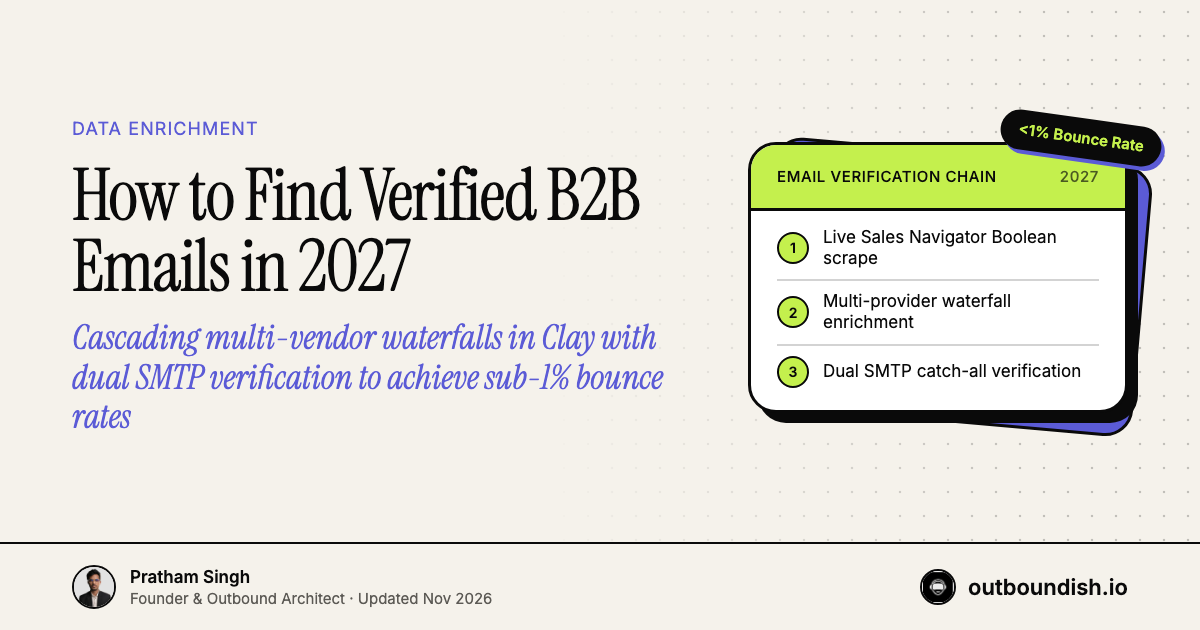
Rather than relying on one static vendor, modern revenue operations build waterfall data enrichment pipelines in Clay. In a waterfall workflow, multiple specialized data providers are queried sequentially in order of accuracy and cost efficiency:
// 2027 Clay Waterfall Data Architecture
1. Ingest Prospect Profile → LinkedIn Sales Navigator URL
2. Query Tier 1 Provider (Prospeo) → If Verified: Proceed to SMTP Check
3. If Missing → Query Tier 2 Provider (Datagma) → If Verified: Proceed
4. If Missing → Query Tier 3 Provider (Dropcontact / Findymail) → If Verified: Proceed
5. Final Stage → Scrub Catch-Alls via MillionVerifier / Scrubby
6. Output: 99.2% Deliverable B2B Contact Fleet
Comparing Lead Sourcing Methodologies
| Methodology | Match Rate | Average Bounce Rate | Domain Safety Risk |
|---|---|---|---|
| Raw Apollo CSV Export | 50% – 60% | 4.5% – 8.0% | High (Triggers domain blacklists) |
| Single Vendor + Basic Verifier | 60% – 70% | 2.0% – 3.5% | Moderate (Marginal spam trap risk) |
| Clay Multi-Vendor Waterfall | 80% – 88% | < 0.8% | Zero (Pristine domain reputation) |
How to Handle Catch-All Email Addresses
Catch-all domains return a "valid" response to automated SMTP ping tests even when an address is fake. To safely prospect into catch-all domains, use specialized catch-all verification tools (such as Scrubby or TrueLists) that test real SMTP handshake protocols without bouncing, or focus outreach to those specific accounts on LinkedIn where contact delivery is 100% guaranteed.
Want a verified, waterfall-enriched contact list tailored to your exact ICP? Discover how our specialized B2B lead generation agency and dedicated cold email agency manage clean outbound data under our transparent unit pricing model ($1,100–$2,300 pilot, $1,300–$3,700/mo retainer), delivering 8–12 standard to 20–21 enterprise qualified meetings every month.
Data Compliance: Review commercial data collection and legitimate interest guidelines via the UK Information Commissioner's Office (ICO) Direct Marketing Guide.
People Also Ask
Waterfall enrichment queries multiple data providers sequentially in Clay (e.g., Prospeo → Datagma → Findymail). If Provider A fails to find a verified email, the workflow queries Provider B, boosting match rates to 85%+.
Apollo maintains a vast static database that refreshes periodically. Because B2B employees change jobs frequently, static databases quickly become outdated, leading to high bounce rates without secondary verification.
A catch-all (or accept-all) domain is configured to receive emails sent to any address on the domain, making it difficult for standard email checkers to verify if the specific user mailbox truly exists.
Outboundish builds custom multi-vendor Clay waterfall pipelines paired with dual SMTP verification, maintaining sub-1% bounce rates and booking 8–12 standard to 20–21 enterprise qualified meetings monthly under our $1,300–$3,700/mo retainer.