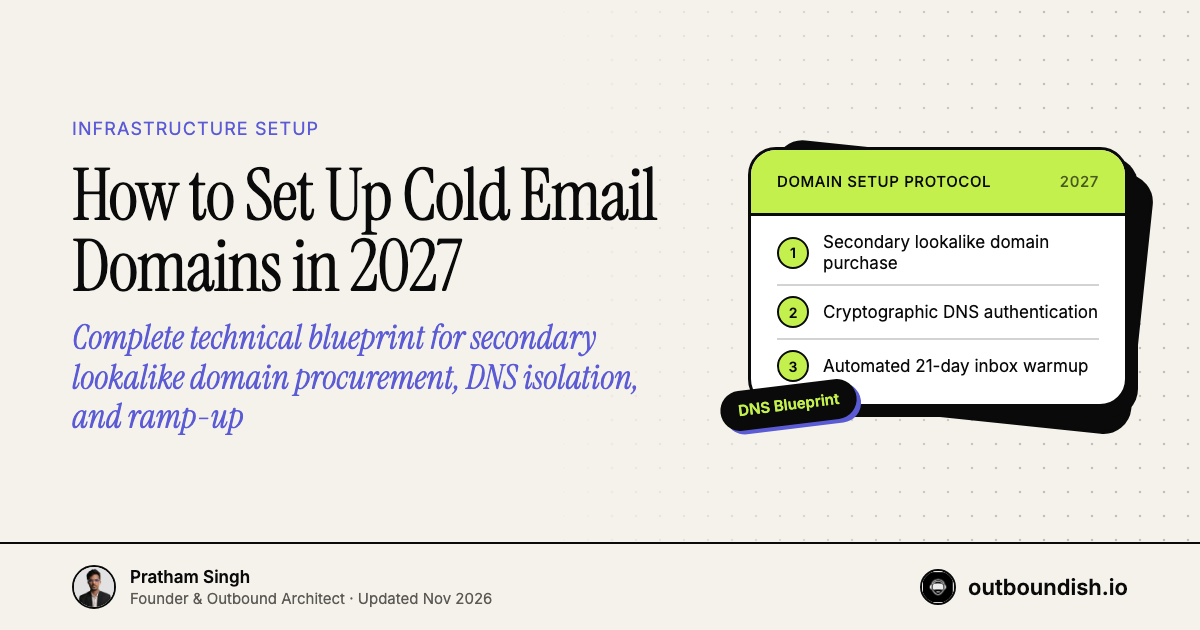
The 2027 Strategic Shift
TL;DR: The Core 2027 Takeaways
- Never Risk the Primary Root Domain: All cold outbound campaigns must run exclusively through secondary lookalike domains (e.g.,
getcompany.comortrycompany.io). - The Core DNS Quad: Every domain requires four synchronized DNS records: SPF (authorized senders), DKIM (2048-bit key), DMARC (enforcement policy), and a custom tracking CNAME.
- Forwarding to Protect Direct Traffic: Set up permanent 301 redirects on all secondary domains pointing back to your main website to capture prospects who type the domain into browser address bars.
The Golden Rule of Cold Email Infrastructure
Before writing a single cold email script or scraping a list of prospects, commit this absolute rule to memory: never send cold outreach from your primary corporate root domain. If your main company website is acme.com, your sales team must never send unsolicited outreach from @acme.com addresses.
If cold prospecting causes a spam complaint spike, your primary domain's reputation will be damaged. This means transactional order receipts, customer support responses, and everyday executive emails will begin landing in your existing clients' spam folders. The solution is building an isolated secondary domain fleet.
Step 1: Selecting and Purchasing Lookalike Domains
Purchase 3 to 5 secondary domains that match your primary brand. Stick to trusted top-level domains (TLDs): .com is ideal, followed by .io or .co. Avoid spam-heavy TLDs like .xyz, .biz, or .club.
tryacme.comgetacme.comacmehq.comuseacme.io
Configure a domain-level 301 redirect on each secondary URL pointing directly to your main website homepage (https://acme.com). When curious prospects type your secondary domain into their browser, they land on your actual website.
Step 2: Configuring Essential DNS Records
In your DNS management console (Cloudflare, Namecheap, or Google Domains), add the following four critical authentication records:
1. SPF (Sender Policy Framework)
SPF specifies which mail servers are authorized to send email on behalf of your domain. If using Google Workspace, add a TXT record with:
v=spf1 include:_spf.google.com ~all2. DKIM (DomainKeys Identified Mail)
DKIM attaches a cryptographic signature to every email header, proving the message was not altered in transit. Generate a 2048-bit key inside your Google Workspace or Microsoft 365 Admin Console and publish it as a TXT record:
Host: google._domainkey
Value: v=DKIM1; k=rsa; p=MIIBIjANBgkqhkiG9w0BAQEFAAOCAQ8AMIIBCgKCAQEA...
3. DMARC (Domain-based Message Authentication)
DMARC tells receiving mail servers how to handle messages that fail SPF or DKIM checks. In 2027, major providers enforce strict DMARC policies:
Host: _dmarc
Value: v=DMARC1; p=reject; rua=mailto:dmarc-reports@acme.com
4. Custom Tracking Domain (CNAME)
To track engagement without sharing sequencer domain reputation, create an isolated CNAME record pointing to your sending tool:
Host: track
Type: CNAME
Value: prox.smartlead.ai
Step 3: Provisioning Inboxes & Warming Up
Create no more than 2 to 3 user mailboxes per secondary domain (e.g., alex@tryacme.com and sarah@tryacme.com). Connecting 10 inboxes to a single secondary domain raises immediate red flags with domain registrars and email providers.
Immediately connect your new inboxes to an automated warmup tool like Smartlead or Instantly. Keep inboxes in pure warmup mode for a minimum of 14 to 21 days before dispatching your first live cold email campaign.
Want your entire domain fleet provisioned and warmed by experts? Discover how our specialized B2B lead generation agency and dedicated cold email agency manage turnkey outbound infrastructure under our transparent pricing model ($1,100–$2,300 pilot, $1,300–$3,700/mo retainer), delivering 8–12 standard to 20–21 enterprise qualified meetings every month.
Technical Standard: Review the formal protocol specification for email domain authentication via IETF RFC 7208 Sender Policy Framework Specification.
People Also Ask
A secondary domain is an alternative domain name closely resembling your main brand (e.g., getcompany.com if your main site is company.com), used exclusively for cold prospecting.
Purchase secondary domains through reliable registrars like Namecheap, Cloudflare, or Porkbun, avoiding obscure top-level domains like .xyz or .top.
Stick to established, trusted TLDs: .com is the gold standard, followed by .io, .co, or country-specific TLDs like .co.uk or .de for regional outreach.
Outboundish handles 100% of domain procurement, DNS configuration, and automated warming, handing over full domain ownership to clients under our $1,100–$2,300 pilot and $1,300–$3,700/mo retainer.