Most teams treat outbound sales automation like a volume dial. Buy a sequencer, connect five mailboxes, blast 200/day, watch opens dip, then blame “the algorithm.” Domains do not burn from automation itself. They burn from automation without capacity math, verification, or stop rules.
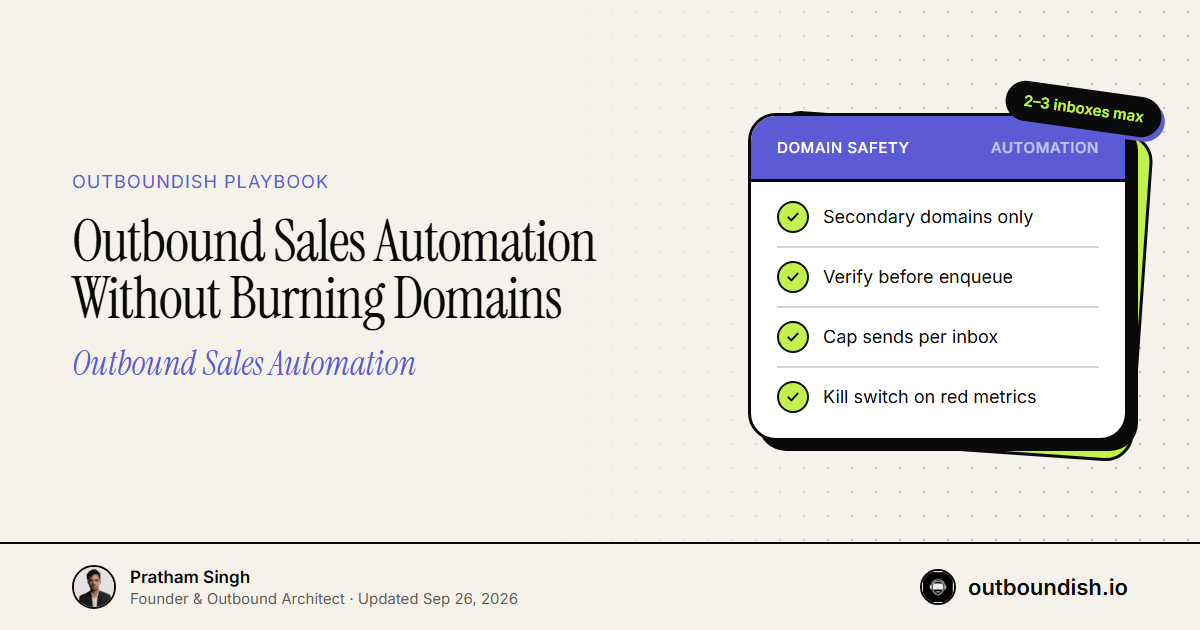
If your primary corporate domain is on the sequencer, stop. Everything below assumes secondary lookalike domains only.
What breaks first (and why)
Automation fails in a predictable order:
| Failure | Symptom | Root cause |
|---|---|---|
| List rot | Hard bounces spike | Unverified / catch-all / role accounts |
| Ramp abuse | Sudden spam folder | 5 → 80/day overnight on cold inboxes |
| Copy spam | Complaints / unsubs | Same template across every persona |
| No kill switch | Whole portfolio filtered | Volume kept after metrics already red |
Outbound sales automation is leverage on top of infrastructure. It is not a substitute for SPF/DKIM/DMARC, warmup, or an ICP that can actually buy.
Capacity before cadence
Backsolve from held meetings, not from “how many emails Smartlead can fire.”
Conservative planning defaults many operators use:
- 2–3 sending inboxes per secondary domain
- ~15–25 cold sends per inbox per day after warmup
- Warm buffer equal to 25–50% of production capacity
- Hard bounce rate treated as a red line, not a dashboard curiosity
Worked sketch for ~25 held meetings/month: if reply rate is ~2.5% and ~25% of replies become held, you need roughly ~4,000 sends/month (~200/day). That is about 10 warmed mailboxes—not one hero inbox with a heroic daily cap.
Portfolio math belongs next to the sequencer settings. Pair this with Cold Email Domain Portfolio Architecture and the DNS playbook: How to Set Up Email Domains for Outbound Campaigns.
Automation that is allowed to be boring
Good outbound sales automation looks dull on purpose:
- Verify before enqueue. No catch-alls in the primary send pool.
- Ramp per inbox. New mailboxes earn volume; they do not inherit last week’s caps.
- Rotate domains. Spread risk so one filtered asset does not halt the month.
- Human reply handling. Sequences stop on human reply; AEs own the thread.
- Kill switches. Pause a domain/inbox when bounces, spam placement, or complaints spike—before the rest of the portfolio inherits the damage.
If you need recovery, do not “send harder.” Use How to Fix a Burned Cold Email Domain and treat the asset as compromised until metrics recover.
Sequencer settings that protect reputation
| Setting | Prefer | Avoid |
|---|---|---|
| Daily cap | Conservative, per inbox | Shared “team” caps that overload one domain |
| Custom tracking | Off or carefully tested | Open-pixel obsession that hurts placement |
| Link load | One clear CTA | Five tracked links in email one |
| Reply stop | Instant on any human reply | Continuing the sequence after “interested” |
| Sending windows | Prospect timezone, business hours | 3am spray-and-pray |
Outbound sales automation should optimize for held meetings, not open rate theater. Opens are noisy; hard bounces and complaint signals are not.
List and offer still beat software
Clay + Apollo + Instantly will not save a fuzzy ICP. If your “automation” is enriching random SaaS companies and pasting the same pain line, you are industrializing waste. Tighten firmographics, triggers, and exclusions first. Then automate the repetitive parts: enrichment, personalization tokens you can defend, mailbox rotation, and SLA routing for positives.
When to buy more domains vs fix the system
Buy more domains when caps are hit and bounce/complaint rates are healthy and reply quality is acceptable. Do not buy more domains to outrun a bad list or a weak offer. That is how portfolios die expensive deaths.
Pricing reality check
If you outsource this motion, expect retainers in the $1k–$2k/mo band for serious B2B outbound ops, with unit economics framed around $100–$150 per held meeting—not booked placeholders that no-show. Booked ≠ held. Protect show rate or your automation ROI is fiction.
Bottom line
Outbound sales automation without domain discipline is a reputation incinerator with a nice UI. Cap sends, verify lists, rotate assets, stop on replies, and measure held meetings. Scale the system that survives a bad week—not the one that wins a single dashboard screenshot.
People Also Ask
No. Automation hurts deliverability when volume, list quality, or ramp rules are reckless. Conservatively capped, authenticated secondary domains with verified lists can scale safely.
No. Keep the corporate domain off cold sequences. Use secondary lookalike domains so filtering risk stays isolated.
After warmup, many teams stay roughly in the mid-teens to mid-twenties per inbox per day for cold. Raise only while bounce and complaint metrics stay clean.
Pause on hard-bounce spikes, spam-folder signals, elevated complaints, and any human reply. Domains and inboxes should be pausable independently.