A chaotic outbound sales process—sending a cold email on Monday, forgetting about the account, and emailing again three weeks later—destroys sales velocity.
High-performing outbound teams run deterministic multi-touch cadences. By choreographing touchpoints across cold email and LinkedIn, you build familiar brand awareness before asking for executive calendar time. Senders must align cadence frequency with technical requirements like Google Email Sender Guidelines.
The 14-Day Dual-Channel Cadence Blueprint
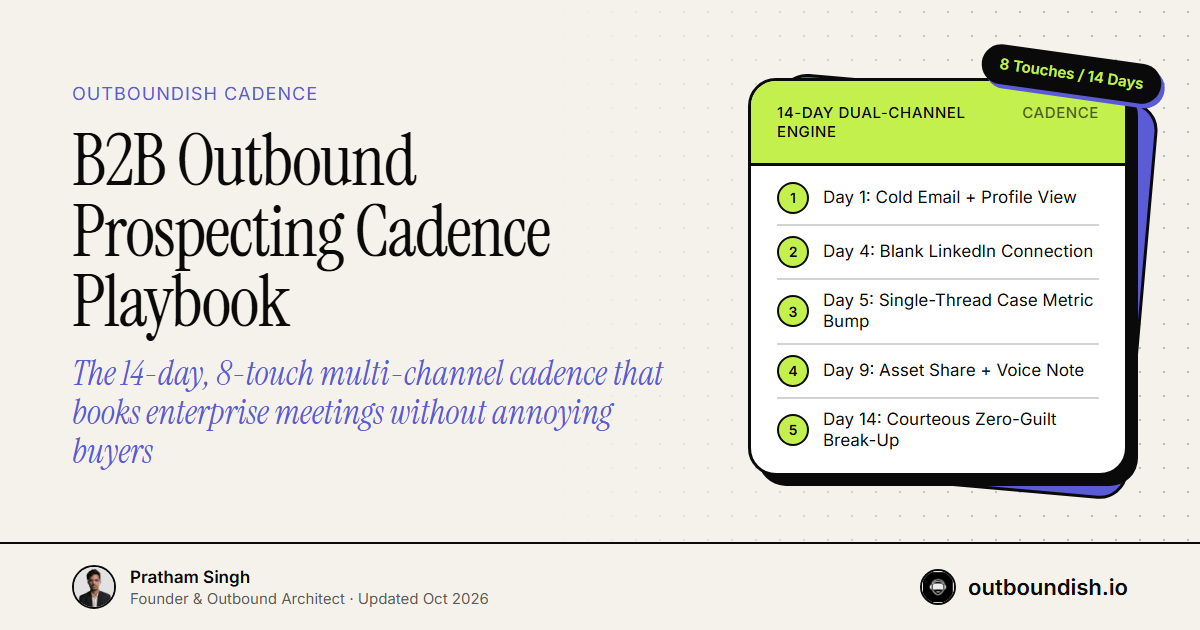
Here is the exact 8-touch sequence Outboundish uses to book 20–30 enterprise meetings per client monthly:
| Day | Channel | Touch Type | Strategic Objective |
|---|---|---|---|
| Day 1 | Profile View + Follow | Soft visibility on prospect's notification feed | |
| Day 1 | Cold Email | Touch 1: Pain Observation | Concise 4-line problem frame; soft interest CTA |
| Day 4 | Connection Request | Blank or ultra-brief non-salesy invite note | |
| Day 5 | Cold Email | Touch 2: Metric Proof | Reply in same thread with 1 named customer result |
| Day 8 | Engagement | Like or thoughtful comment on prospect's recent post | |
| Day 9 | Cold Email | Touch 3: Asset Bump | Share a 2-page teardown or relevant framework |
| Day 12 | Soft DM / Voice Note | Casual check-in referencing previous email thread | |
| Day 14 | Cold Email | Touch 4: Polite Break-Up | Graceful exit removing pressure; leaves door open |
Why Single-Thread Email Follow-Ups Win
Always send your email follow-ups (Touches 2, 3, and 4) as replies within the same email thread (using the same subject line with Re:).
Starting a brand-new thread with a different subject line forces the prospect to evaluate you as a stranger all over again. Threading previous messages gives the executive instant context on why you contacted them initially, preserving conversational continuity.
The Power of the Graceful Break-Up
Over 25% of our positive client responses come from the final "break-up" email. Executives are busy and frequently miss emails they meant to reply to.
When you send a courteous note stating: "Assuming this isn't a priority right now, John—won't clog your inbox further. If solving [Pain] comes back up in Q1, happy to reconnect," it removes sales tension. Prospects appreciate the professionalism and often reply: "Thanks for following up, Pratham—actually, let's talk next Thursday."
People Also Ask
A B2B outbound prospecting cadence is a structured schedule of sequential touchpoints (cold emails, LinkedIn profile views, connection requests, and follow-ups) delivered over a set timeframe to engage high-value B2B decision-makers and secure a qualified sales meeting.
An ideal B2B outbound cadence lasts between 12 and 16 business days and contains 6 to 8 total touchpoints across two channels. Spreading touches out over this timeframe prevents prospect fatigue while ensuring you catch executives across different working rhythms.
Wait 3 to 4 business days between initial email touches. Sending daily follow-ups ('Did you see my email yesterday?') annoys busy executives, accelerates spam complaint reports, and signals low-status desperation.
A break-up email should be polite, respectful, and zero-guilt. State that you assume this is not a current priority, reiterate one concise problem you solve, and leave the door open for future contact without asking for a meeting.
Keep Building The Engine
Want dedicated secondary inboxes, multi-pool mailbox rotation, and guaranteed primary placement managed for your team? Explore how our done-for-you cold email agency infrastructure pods run outbound without risking your domain portfolio.